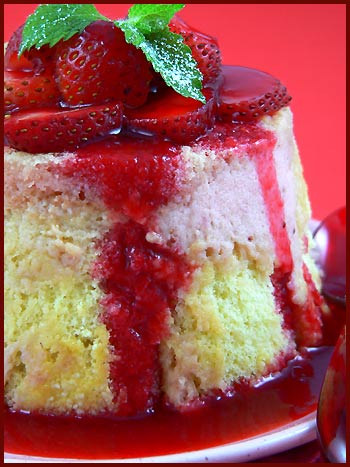
What is Your Name? Charlotte? But Who Are You?
Before I was born into this world, my parents were already faced with a dilemna with me. Here it was, the baby was to be a girl, and they did not know what name to give to me. No surprise as most parents are faced with this issue! After much debate, they narrowed down the endless list of firstnames to two possibilities. But they still hesitated. I was going to be called either Béatrice or Anne. And for some reason, I ended up with Béatrice. Did I like my name? I actually had no choice, but for the longest time, I just hated Béatrice as my firstname. So much so that no one in my home village in France knows me under that name. As a matter of fact, instead, I wish I had been called Charlotte!
Charlotte is a firstname that I have always loved. I found it fresh, happy and melodious. If asked what it is that I like about it, I would reply “c’est sa mélodie” (it is its melody). But here are also some facts. I guess Charlotte is a firstname way more popular than Béatrice! In 2003, 2287 French baby girls were named Charlotte, against only 27 Béatrice. Charlotte is also the 28th most popular female firstname in France, while Béatrice holds the 765th position. My firstname is pretty old-fashioned! Well that is not the point. What I should actually admit is that Charlotte is the name of one of my favorite French actresses, Charlotte Gainsbourg, and that it is the name given to a dessert that I am obsessed with. Really obsessed with.
Charlotte Or How to Use Homemade Ladyfingers
Deliciousness, airy, cream, chantilly, fruit, berries, fresh, summer, light, picnic, grandes vacances are all our words that come to my mind when I think about a charlotte. I still remember my brother and I begging my mum to make a charlotte every weekend during les grandes vacances (summer vacation), when friends would come over for dinner. We could just never have enough of it. Around the time when it was the prime season for red berries such as strawberries or raspberries, it was just the perfect excuse to use the excess of those fruits rouges (red fruit).
“Mais qu’est-ce que je vais faire avec toutes ces fraises ? “, my mum would often ask. (What am I going to do with all these strawberries?)
“Une chaaarloootteuuuu, s’il te plaît maman !”, was our answer. “Ca va vite, hein, dis! C’est facile !”
“Yes, it is an easy dessert !”, she would admit.
My mum used to make hers in a special Tupperware charlotte mold, with which unmolding the charlotte was really made easy. While in France in late May this year, my sister-in-law and I had decided to cook lunch for Mother’s Day. While Geneviève was in charge of making amuse-bouches along with the main course, I prepared the appetizer and the dessert. And, oh yes, let me tell you how it felt when, by accident, after poking around in my mum’s kitchen cabinets, I found her white tupperware mold hidden behind a pile of unused stuff! I had found an old hidden treasure! When I showed the mold to her, she even added:”Tiens, il existe encore celui-là ?” (This one sill exists?) I had my dessert, just in front of me. We had heaps of juicy strawberries in the garden, there was cream in the fridge and a box of biscuits à la cuillère in the pantry. I was excited. I had not made or eaten a charlotte in ages!
I am not sure why I am so obsessed with this dessert. Maybe it has to do with its slightly slanted shape, from looking elegant to decadent, perfect to imperfect, rustic to classy. A charlotte is, to me, all those things together. It is reminiscent of times spent as a young girl during les grandes vacances, when all I needed to worry about was nothing! My friends and I used to spend our afternoons running in fields to steal ripe fruit from trees, cycle around in the village, and relunctantly help our mums to clean peas or French beans. On trainait au village ! (we used to hang out in the village!) It was the time when we were allowed to stay up because the sun would set so late. During that time of year, we used to eat a lot of charlottes with red fruits.
If you want to know, a charlotte derives from an old English dessert made of buttered slices of white bread with a filling of apples and fruit marmalade, cooked and served with a crème anglaise. From this dessert, Antonin Carême invented the charlotte à la russe, an entremets frappé eaten cold, which requires no cooking time. It typically would be made of a vanilla cream base (or a chocolate or coffee mousse, whipped cream or an appareil à bombe) poured into a dish lined with alcohol-flavored ladyfingers, before being placed in the fridge for a few hours. The truth is that, although looking like a complex dessert, a charlotte is in many ways easy to make and forgiving. You do not need to have excellent pastry skills. In fact, I love that no cooking time is required to make it (unless you make your own ladyfingers). The kind of “Mince, mon gâteau n’a pas monté !” (Crap, my cake did not rise!) never happens!
The recipe I decided to make was pretty much what I recalled my mum’s charlotte used to look like. She wouldn’t, however, use gelatin as I did, in which case the cream would just be somewhat more runny. Same deliciousness though!
On Mother’s day, not usually being much of a dessert person, my mum happily surprised me when I came to the table, my hands holding the charlotte aux fraises et son coulis made the night before. We all ate a slice each, before she asked the first: “j’en reprendrais bien une petite tranche!” (I would not mind a second serving!) It was her fête after all! Mum, you made my day!
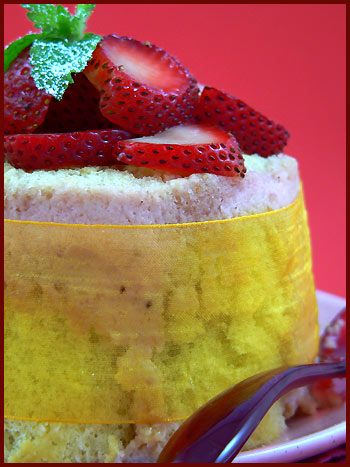
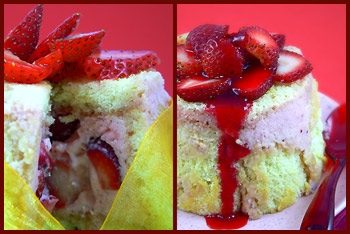
Charlotte aux fraises – Strawberry Charlotte
Note: In the recipe featured here, I made small charlottes, with molds measuring 4 ” diameter, 2.5″ high. If you want a big one, the cream base stays the same in quantities, but you might simply need less ladyfingers.
Use two batches of the biscuits a la cuillère here, or buy some.
You need:
For the Strawberry Cream
- About 48 small ladyfingers ( 2.5″ long), less if you make a big charlotte
- 10.5 oz fresh strawberries + a few more
- Dash of lemon juice
- 5 oz sugar
- 4 gelatin sheets
- 1 + 1/4 cup heavy cream
For the Syrup
- 1/4 cup minus 1 Tbsp fine sugar
- 5 Tbsp water
- 2 oz strawberries
- A dash of lemon juice
- (optional 2 Tbsp raspberry liqueur)
For the Raspberry Coulis
- 10.5 oz raspberries
- 4 Tbsp fine sugar
- A dash of lemon juice
Steps:
- Start by preparing the syrup. Mix the strawberries in a food processor and strain them to remove the seeds.
- Boil the sugar and water for 1 mn.
- Let cool down and add the strawberries purée with the lemon juice (and liqueur if using). Mix well and let cool down.
- To make the strawberry cream, start by soaking the gelatin sheets in cold water.
- Purée the strawberries in a food processo, and strain them to remove the seeds.
- Mix the strawberry purée with the sugar.
- Pour half of the strawberry purée in a pot and heat it.
- Squeeze the excess water from the gelatin sheets and add them to the heated strawberry purée to dissolve them. Mix well.
- Add the rest of the strawberry purée and mix.
- Add a dash of lemon juice.
- Using a mixer, whip the cold cream into firm whipped cream (chantilly).
- Add 1/3 of the whipped cream to the strawberry purée, making sure to describe large movements, so as to keep the preparation light.
- Add to the rest and mix carefully.
- To make the coulis, purée the raspberries and strain to remove the seeds.
- Heat the purée in a small pot, then add the sugar with the lemon juice.
- Remove from the heat and let cool down.
- To finish your dessert, take a charlotte mold.
- Dip the ladyfingers quickly in the syrup.
- Place the first ladyfingers at the bottom (cut them if too big).
- Line the mold with the other ladyfingers dipped in the syrup, round face out.
- Pour half of the cream in the mold, and add freshly cut strawberries.
- Pour the rest of the cream and finish with ladyfingers.
- Cover with a plastic film, and put a plate on the charlotte, to serve as a weight.
- Place in the fridge overnight, or a minimum of 4 hours, so that the gelatin is set.
- To unmold the charlotte, run the blade of a sharp knife around the edge of the mold, and flip it over on a plate.
- Serve with the raspberry coulis and more strawberries.
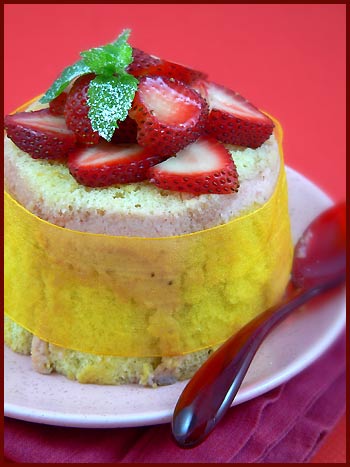
Le coin français
Remarque : dans cette recette, j’ai fait des petites charlottes, avec des moules mesurant 10cm de diamètre et 6,25 cm de haut. Pour une charlotte plus grande, il vous suffit d’utiliser moins de biscuits à la cuillère. Les proportions pour la crème restent les mêmes.
Utilisez deux fournées de biscuits a la cuillère ici, ou bien achetez-en.
(Pour 4 petites charlottes, ou une grande)
Ingrédients :
Pour la crème aux fraises
- Environ 48 petits biscuits à la cuillère (6 cm de long), moins si vous réalisez une grande charlotte
- 300 g de fraises + quelques fraises de plus
- Jus de citron
- 150 g de sucre fin
- 4 feuilles de gélatine (8 g)
- 30 cl crème liquide froide
Pour le sirop
- 40 g sucre fin
- 5 càs d’eau
- 50 g fraises
- Jus de citron
- (2 càs de liqueur de framboise, facultatif)
Pour le coulis de framboises
- 300 g framboises
- 4 càs de sucre fin
- Jus de citron
Étapes :
- Commencez par préparer le sirop pour les biscuits à la cuillère.
- Mixez les fraises en purée.
- Passez-les au tamis pour en retirer les pépins.
- Faites bouillir l’eau avec le sucre pendant 1 mn.
- Laissez refroidir avant d’ajouter la purée de fraises (et la liqueur si vous l’utilisez), avec le jus de citron.
- Mélangez et réservez.
- Pour préparer la crème, faites tremper les feuilles de gélatine dans de l’eau froide.
- Mixez les fraises en purée, et passez-les au tamis pour en retirer les pépins.
- Mélangez la purée de fraises avec le sucre.
- Faites chauffer la moitié de cette préparation dans une casserole.
- Essorez les feuilles de gélatine et ajoutez-les à la purée de fraises chaude.
- Mélangez bien pour dissoudre la gélatine, puis ajoutez le reste de purée de fraises, avec le jus de citron.
- Montez la crème froide en chantilly.
- Ajoutez 1/3 de cette préparation à la purée de fraises, en prenant soin de mélanger délicatement.
- Ajoutez le reste de la chantilly. La préparation doit rester aérée.
- Pour préparer le coulis, mixez en purée les framboises et passez-les au tamis afin d’en retirer les pépins.
- Dans une casserole, faites chauffer la purée de framboises, puis ajoutez le sucre pour le dissoudre.
- Ajoutez le jus de citron et réservez. Laissez refroidir.
- Pour monter la charlotte, commencez par rapidement tremper les biscuits à la cuillère dans le sirop refroidi.
- Prenez un moule à charlotte et tapissez-en le fond avec des biscuits à la cuillère (coupez-les s’ils sont trop grands).
- Tapissez les bords du moule avec le reste des biscuits.
- Versez la moitié de la crème à la fraises, puis ajoutez des fraises fraîches coupées.
- Continuez avec le reste de crème, et terminez avec des biscuits.
- Couvrez avec un film plastique, et posez une assiette dessus.
- Mettez au frigidaire toute la nuit, ou au minimum 4 heures, afin que la gélatine prenne.
- Pour démouler la charlotte, passez la lame d’un couteau bien aiguisé le long des bords, et renversez-la délicatement sur une assiette.
- Servez la charlotte accompagnée du coulis de framboises et de fraises fraîches.
Alors tu me croiras ou non, j’ai fait hier presque la même charlotte aux fraises, mais avec des biscuits roses de reims. Pour la mousse, j’ai utilisé de la pulpe de fraises (mais j’ai laissé les akènes), de la mascarpone au lieu de la crème fouettée comme toi. Le seul souci, c’est que ma mousse ne se tenait pas assez, je n’ai certainement pas mis suffisament de gélifiant (agar-agar). Je pense que pour ce genre de gâteau, il faudrait intercalé du biscuit génoise du diamètre du moule et d’en faire plusieurs étages pour que l’intérieur soit plus structuré qu’avec les biscuits qui donnent un côté “fouilli”. Elle était très bonne par contre ! Du coup, j’essairai la prochaine fois avec ta base de mousse 😉 En tout cas, la présentation est sympa !
Je ne suis pas amateure de dessert à base de crème et la chantilly, ce n’est décidément pas mon truc mais je sais reconnaître la beauté des choses et là, ce dessert est incontestablement beau ! Ces fraises éhontément rouges sont magnifiques et les photos sont, comme toujours, sublimes…Bref, une réussite totale quoi 😉
Very dramatic presentation!
Charlotte is so beautiful! Elegant and Classy. Just like you, Bea. 🙂
I think your firstname is in … And your Charlotte is beautiful … I dislike have a firstname who is a cake’s name…
ça c’est bien une charlotte faite par une jeune femme qui dans le temps révait de s’appelait ainsi… cela ne fait aucun doute! qu’il était doux et agréable de lire l’histoire de ton amour pour ce dessert que j’aime également énormément! je garde précieusement ta méthode et ta recette… même si je sais par avance que je ne ferais certainement pas quelque chose d’aussi somptueux: c’est à tomber!!
Une bien jolie présentation !
Hey, Bea! Ca me parait tres tres delicieux et frais! Un choix parfait pour les chauds jours (et nuits) d’ete!
J’aime beaucoup comment tu as fait la stylistique culinaire (je ne suiis pas tres sure si c’est le mot pour food sylist)
J’ai une predilection pour les desserts et c’est un dessert qu’on doit essayer!
merci de partager!
amities!
elle est super belle ta charlotte!!!
J’adore aussi ce prénom, il me renvoie toujours l’image d’une gamine avec des couettes! Par contre, je n’ai jamais mangé, ni préparé de Charlotte de ma vie! Beautiful, as usual…
Béa, I’m in awe! The pictures are beyond beautiful and your story from beginning, middle and end is so incredibly filled with lovely memory. I think it so fitting your mum would ask for seconds. Please I’d be happy with just one – looks sooooo good. Happy Day.
Béa, what a lovely charlotte. I really like any dessert with fruit.What an amazing thing to prepare for your mum.
j’ai adoré l’histoire de ce long post, et ta charlotte est super aussi bien sûr, mais bon, je crois que je préfère encore l’anecdote trop bien racontée!
bonjour,
que c’est beau, et bon !
Très beau site!
ciaoo,lory
I have to say, I am not a cook and did not read all of the detailed recipe, but the photos here are absolutely delicious! Merci !
La première photo est à tomber. On aime tout, l’histoire liée au dessert.
moi aussi j’ai longtemps détesté mon prénom : je le trouvais trop agressif … et finalement, maintenant je m’y fais … je me rend compte que toutes les “Béatrice” que je rencontre sont des femmes de caractère, pleines de vie et d’humour, combatives, exigeantes (par opposition à la médiocrité), et j’en passe …Charlotte est un prénom de petite fille, Béatrice est un prénom de femme … un prénom que j’apprends à apprécier !
This charlotte seems perfect for a romantic dinner… I hope it works:)
Salut Béa! Je lis ton blog depuis quelques temps sans n’avoir jamais laissé un commentaire, et je suis une grande admiratrice de tes magnifiques photos. C’est un vrai plaisir des yeux! Mais aujourd’hui ton post m’a interpellé , alors je me dois de te laisser un commentaire. Je m’appelle Charlotte, et quand j’étais petite j’ai aussi eu cette fameuse crise, je n’aimais pas mon prénom. Je voulais qu’on m’appelle Olympe, mon second prénom. Je suis née en 1980 et Charlotte n’était pas très populaire à cette époque, je n’ai jamais rencontré quequ’un de ma génération ayant le même prénom que moi. Aujourd’hui j’adore mon prénom. J’aime bien la charlotte en dessert aussi! Continue de nous faire rêver avec tes magnifiques réalisations!
je fonds, un merveilleux dessert pour finir un dîner savoureux.
Lilo, ah oui comme tu dis, coincidence marrante! Meme quand c’est fouilli, c’est delicieux, pas vrai ?
Merci Ingrid, c’est un super compliment, ca!
Hi Gerald, thanks. I guess you are right, I did think about this angle at first, but now that you say it…
Ah Mae, you are too sweet, thanks so much!
Fabienne, thanks. Nice of you to say so. I grew to like my name, but it took a long time!
Alhya, merci, trop gentil ! Je suis sure que tu te debrouilleras super bien !
Choupette, merci !
Alita, merci de ton passage !
Audrey, merci!
Mitsuko, ahah, marrant car j’en porte parfois, des couettes ! Merci !
Tanna, ah you are really make me blush here. I was happy to please my mum indeed with my food, as for most of my life, she was the one doing so! Little things, isn’t it?
Valentina, thank you very much!
Mercotte, ah oui, ces bons souvenirs, ca fait du bien, pas vrai ?
Lory, merci beaucoup !
Eric, glad you like it!
Venor, merci bien a toi ! Ca fait plaisir !
Oui Beate, tu as raison, heureusement que je me suis mise a l’aimer, comme toi !
Gagatka, yes I think so too. Are you making it for a romantic dinner?
Charlotte, bonjour ! Merci de ton gentil commentaire. Eh oui, j’adore ton prenom, comme le dessert ! Tres contente de savoir que tu apprecies mon site. A bientot !
Anne, oui, n’est-ce pas ? une simple douceur !
I would ask for seconds too.
Une charlotte. C’est si bon! Bon dimanche
T.
oh, qu’elle est bien belle cette Charlotte. J’ai bien pensé à toi tout à l’ heure. Je rentre de Bitche par Wuisse, Insming, Albestroff……
Hello Bea,
I thank you for your nice email and say again how lovely & passionate is your blog. As to your name – both are lovely. Funny how we never like our names! One of the finest women I ever met (my mother in law) is Charlotte. One of the smartest funniest women I ever enjoyed was Aunt Bea from the Andy Griffith show. Aunt Bea was always in the kitchen. Our company even considered a menu dedicated to Aunt Bea – a future project. So whether Charlotte or Bea – it’s not in the name / it’s in the heart – something you seem to have an abundance of!
Looks so lovely. I have not thought to make a charlotte before, but now I can’t wait for the berry season here!
This was such a lovely post Bea! I can totally relate to the name thing. I used to hate my name because it was so different, no one could ever pronounce it, and I always had to explain it. Today, I’ve grown into it and appreciate that it’s different!
Your charlotte looks beautiful and you’ve inspired me to try this recipe – I’ve never tried making one before!
I am sad to admit that I have never had one of these. Can you believe it? It looks beautiful and delicious though. You have convinced me that I will have to fill this hole in my culinary life!
Elle est, bien sur, de toute beaute. J’aime bien les versions individuelles.
Ah yes Natalie! 😉
Tarzile, c’est vrai cela, Toi aussi, j’espere bon dimanche!
Cocopassions, ah super cool! Trop marrant!
Donna, thanks so much for your very kind message!
Emma, yes I bet! Summer is at the corner, and you don’t even know it!
Geneve, I can see that it must have been a hard name to have first here. My sister-in law is Genevieve as well!
From our Kitchen, you have to try, definitely. You might get hooked, like me!
Gracianne, oui, elles sont vraimenr mignonnes, en version individuelles!
des photos à tomber et une évocation immédiate à l’univers gainsbourien, avec Un Charlotte teinté de Melody Nelson, il em’en fallait pas plus pur tomber dans le filet… ( ra la la ce foot…) panneau voulais-je dire.
Michael-
if you are still into this kind of thing- i want you to know, I still miss the Charlotte mold you stole in 1990-
Bea- nice!!!
Too beautiful Bea, I’m beyond words.
I can’t to try my hand at ladies fingers.
I wish my name was Charlotte … then I would eat this everday!
My daughter is named Charlotte and, appropriately, loves this dessert and wishes I had time to make more of them!
Merci Lilizen, ahah oui le filet comme tu dis!
Kim, thanks
Bron, thanks for your nice note! Hope you try the ladyfingers, you would have no problem making them.
Ivonne, indeed 😉
AH yes I am sure she would like more charlottes!
Tu as raison c’est un prénom délicieux !
Et si doux à l’oreille et indissociable du dessert aussi bien que dela figurine, mais si tu connais j’en suis sûre : charlotte aux fraises et ses petites amies !!…lol
Magnifique photo Béa !
I have been designated for making dessert when we go to my inlaws for dinner on the weekends. They always ask me to make charlotte aux fraise and before coming to france i have never heard of it or seen it. I am so excited to make this recipe they will be so surprised. But your picture looks like you used sponge cake is it becuase they were soaked in syrup? Also I am not sure I understood well, do you put lady fingers on bottom and then up along the sides and then fill with cream and than put more lady fingers on the top?
E grande io ha trovato il vostro luogo! Le info importanti ottenute! ))
jolie charlotte
Bea what a fun and adorable story!!!! I recently discovered your blog and I’m so happy I did! You give great recipes and ideas and the pictures are just wonderful!!!!! my birthday is coming up and I’m thinking of making a strawberry charlotte just looking at this picture. Thank you for sharing all that knowledge and fun!!!!
Ok, I just made it finally! my first charlotte…i thought it would never happen. bought the ingredients so many times, and finally…its sitting in the fridge waiting to set. I am going to bring it to work tomorrow for my friends birthday…He is french and i know he’s gonna be so happy! But…how to get it to look like yours?? I know its not going to be like that…did you use lady fingers? it looks like sponge cake in the pic.
Mary, thanks so much for your visit!
Pessy, I made these lady fingers, hence they are not as “professional”. But since then, I managed to improve my skills with them 😉 practice. Good luck. let me know how it turns out!
I was trying to find a chocolate version of this to make for my upcoming birthday. Would you recommend using a chocolate cake base and maybe chocolate ganache instead of the raspberry sauce?
Hi Amanda, yes a chocolate base, like a génoise would work. Then I would still use ladyfingers, and then a chocolate filling too. To serve, I would actually favor a crème anglaise instead of the raspberry sauce (vanilla custard). Hope this helps. Good luck!
Salut Béa,
Je lis souvent ton blog et adore, autant les photos que les recettes et les bonnes idées. C’est amusant ton commentaire au sujet de ton prénom, je m’appelle Anne et ma soeur Béatrice! Et j’aime beaucoup les charlottes (aux fruits). Bonne continuation et merci de partager.
Anne
Pingback: Sunday Laziness, and Popsicles — Paresse du dimanche et sucettes glacées by La Tartine Gourmande
Beatrice, I just recently discovered your blog also, as matter of fact just four hours ago and I already made your recipe for biscuits a la cuillère and they are fantastic, i’m going to be making these lady fingers a lot sice i just simply love them, i’l dunk them in espresso, tea or even cold lemonade! I can’t wait to make Charlotte with these home made lady fingers:)
I also loved the pictures, the charlotte looks beautiful, and the way you presented them was really pretty, where can i find teaspoons like the ones on your pictures, I really like them they look like hard candy!
Thanks so much for sharing all these great recipes and the lovely stories 🙂
How would I substitute a sheet of gelatin with granulated gelatin ? Could you please explain how much granulated equals one sheet ?
Thank you very much.
Hi Lori,
The rule of thumb is that 1 gelatin sheet = 1/2 teaspoon — although gelatin sheets tend to vary in strength too.
Hello !! Bonjour !!
Merci pour ces recettes et ces photos !!!!
J’avais juste une petite question…Est-ce possible de réaliser cette recette sans la gélatine?
Y’a t’il une différence en terme de cuisson si je remplace les fraises par des morceaux de mangue?
Merciiiiiiiiiiiiiiii
Pingback: Mold Preparers Blog » Blog Archive » Quick scan of the net - mold preparer
Pingback: 2 compleanni, 2 torte « thePinkBlog
I hope I am not repeating a question, but what is a gelatin sheet? I have never seen this.
I am so excited to find a good mousse recipe sans eggs that uses gelatin. I will be making this charlotte this Christmas when my sister comes home instead of my usual bûche de Noël. I’m sure ma famille will love it and I can’t wait! Merci, Béa! 🙂