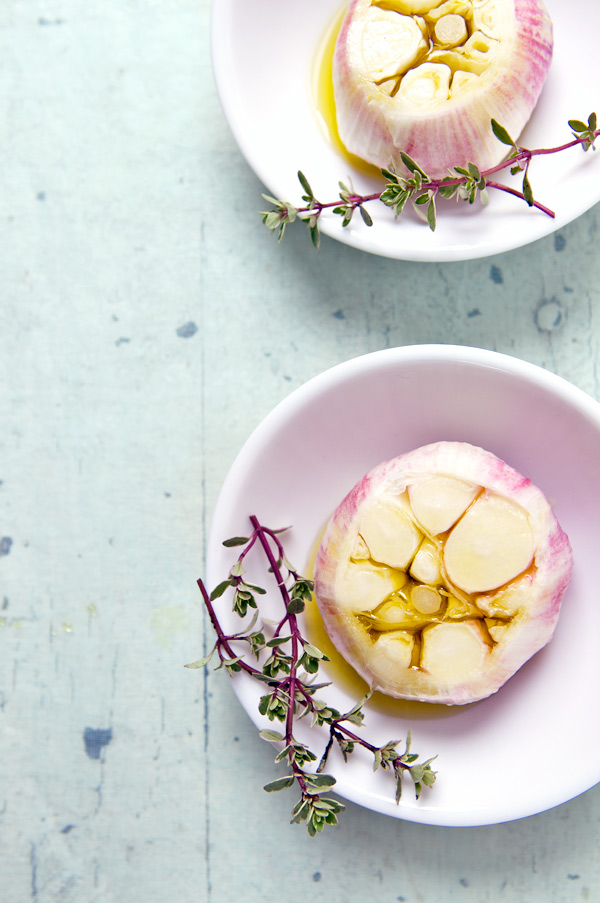
At first, I didn’t know whether it would be making sense that I tell you about the last few weeks.
But then, the more I thought about it, the more I knew it would be a good idea.
Yes.
The past weeks have been hard. I’ve been very ill. Like I’ve never been before.
A nasty virus that confused everyone suddenly hit me. It was a virus that made everyone believe it was something else; it was one that gave me such high fevers–I rarely have fever, on top–that one night, I ended up in the emergency room. And again the week that followed.
I lost weight. I lost my appetite. And while I was lying in bed, what was happening had me thinking. And realize even more what matters.
And what doesn’t.
It’s powerful.
I kept wishing to be able to cook but I couldn’t.
The day that followed our first visit to the ER, Alex, one of P.’s colleagues, asked if he could bring food. I felt so touched to see him come to the house by late afternoon with two large containers filled with homemade green lentil soup .
I loved Alex’s soup. It was nourishing and warmed me to the soul. I wrote him to ask whether I could have his recipe. “I know it will help me to feel better,” I kept telling myself. So I decided to pump my energy and cooked it one day for lunch when Patricia, my mother-in-law, came to help us.
“It’s the first time you are cooking again,” Patricia said when she saw me sorting lentils on the counter top.
She was right.
It felt good to be able to make food again. Alex’s soup had inspired me.
The doctors eventually gave me a diagnosis. I felt lucky because I would have hated not knowing what had happened. But I was anxious too.
“You need to keep the inflammation down,” my PCP added when I met her to discuss my healing process.
“No gluten, no dairy and avoid sugar. Lots of ginger and garlic, and fish oil. You will have to be patient.”
I was listening quietly.
And then I remembered my friend Kumi’s story. The one she told me about once, when friends came to stay with her, and one of the guests did not like garlic.
“Do you realize?” she had exclaimed, looking annoyed. “How can I do this? Everything in my cooking starts with garlic!”
I had laughed. I would have felt just as she had.
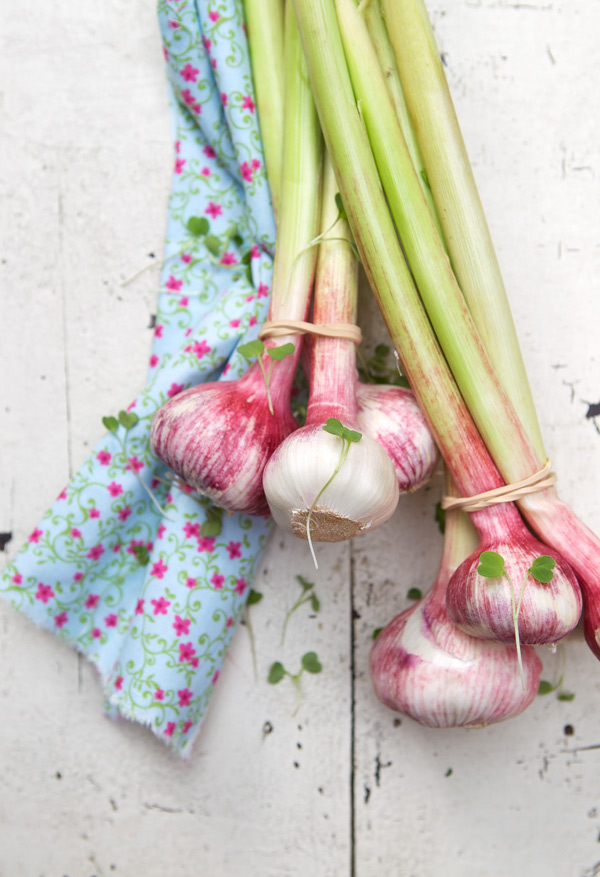
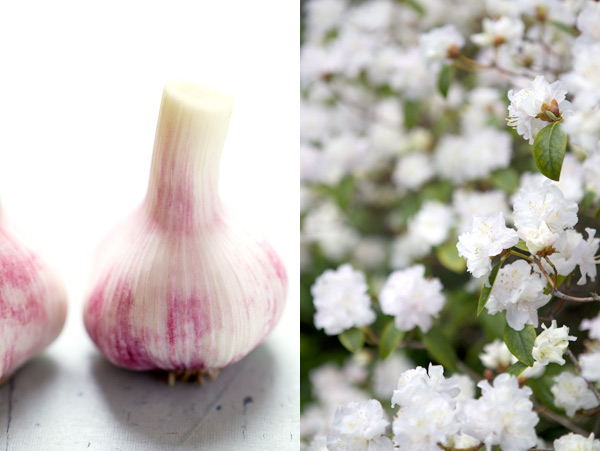
Later that night, while I kept Kumi’s story in my head, I remembered the beautiful heads of spring garlic I had purchased before I became sick. And I decided to roast them.
My body was craving it.
I wanted to feel better.
Heal.
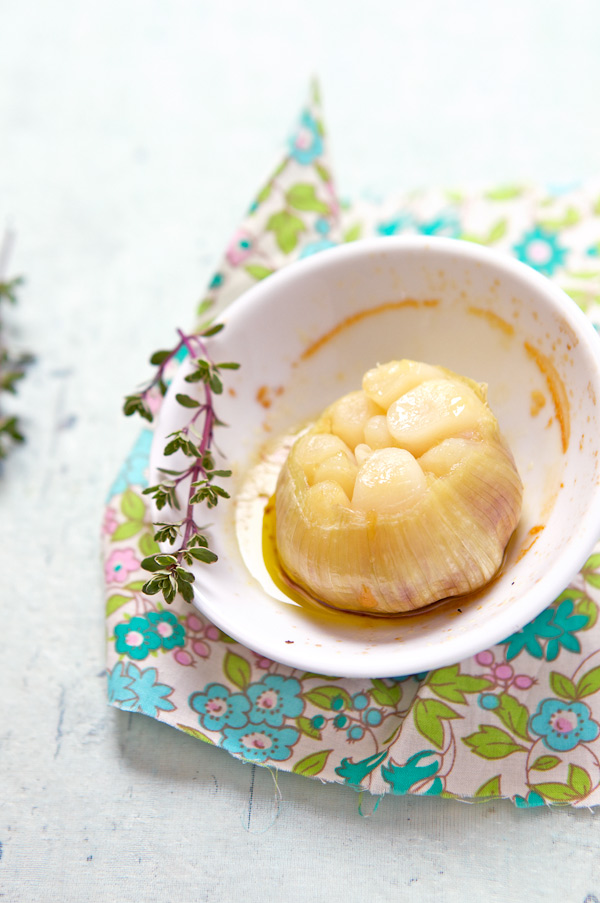
You need:
- Heads of spring garlic
- Olive oil
- Bread or crackers, to serve
Steps:
- Preheat the oven to 400°F and have a baking dish ready.
- Peel the first layer around the heads of garlic and slice the top of each head to reveal the garlic cloves.
- Place the garlic heads in the dish and drizzle each with olive oil.
- Cover with a piece of foil paper and bake for 50 minutes, or until the cloves are soft when you press with your finger. Remove from the oven and allow to cool.
- To eat, spread on bread, toast or crackers.
Ingrédients :
- Têtes d’aïl nouveau
- Huile d’olive
- Pain ou crackers, pour servir
Etapes :
- Préchauffez le four à 200 C et préparez un plat allant au four.
- Enlevez la première couche autour des têtes d’aïl et coupez une rondelle de manière à ce qu’on voit les gousses.
- Mettez-les dans le plat et arrosez d’huile d’olive.
- Couvrez d’une feuille d’aluminium et enfournez pendant environ 50 minutes, ou jusqu’à ce que les gousses soient tendres au toucher. Sortez du four et laissez refroidir.
- Servez avec du pain, des toasts ou des crackers.
That garlic looks wonderfully medicinal and healing (and it’s such a beautiful colour, too). Feel better Bea!
So very glad you are feeling better. Now rest and heal. Take care.
I hope you get well soon! Good thing the food you make has always been nourishing for the body and soul!
Hope you’re feeling your best very soon- garlic is known to have healing properties an dkeep the vampires away so binge binge binge!
Bien contente que tu ailles mieux, et felicitations pour Saveurs, j’ai vote pour tes images :).
I absolutely love the first picture!
I hope you get well soon, Béa! Take care.
Bea, you’ve been missed. What a nasty virus! but glad you’re surrounded by beloved families, friends and good food. Get well soon! xo
I hope you get well soon dear. I’ m sure you will prepare the most healing dishes to help your body and soul!…
Sorry to hear you’ve been unwell, Béa. Thank you always for your inspiring posts, and hope you get well very soon.
I have been following your beautiful blog, but this is my first comment. I hope you feel much better very soon.
La première photo est une des plus belles images de cuisine
que j’ai vu. bravo !
et meilleurs voeux de rétablissement.
Contente de te lire et de savoir que tu es en voie de guérison.
J’ai fait tout récemment aussi des têtes d’ail avec des légumes au four, c’est trop bon et tout crémeux…
I’m glad to hear you are feeling better and hope you get well soon! Good food and your loved ones being close to you make everything better. Take care! I love the first picture, the light and colours are gorgeous.
Hope, you feel better now and get well soon. Garlic, ginger, lemon, camomille are the best natural healers.
So happy to hear you are healing…take good care. xo.
Bea we can hear you feeling better in your voice. Your body needed some rest, almost at times as if an inner reset button is pressed. now starting of with roasted garlic and lentil soup well that is definetely how to heal the inner soul too.
Bon sang que j’adore l’ail !! merci pour cette recette!! Et surtout bon rétablissement.
Bea, So sorry to hear that you have been ill. I am sending you best wishes for a speedy recovery!!! Regards, ~rose
Nothing better than comfort food (& cooking of course) Cooking is just like a wellness-barometre to me!
Get well soon.
Audrey
I love garlic and this is a great recipe! I hope it helps you to get well soon! 🙂
desolee d’entendre tes nouvelles.ce n’est pas facile d’etre malade mais encore plus avec une petite fille ! je t’embrasse et te souhaite un prompt retablissement. Ah L’ail ! c’est divin !
Bea, I hope you will feel better soon! Garlic is good, I love it!
Glad you are doing better and hopefully soon you will feel completely healthy again. 🙂 Best wishes!
Oulala! Heureusement que vous vous sentez mieux! Prenez bien soin de vous!
Mmmm j’ai hâte de tester la recette!
Béa, a few days ago I discovered your beautiful blog!! You are pure inspiration!!! I’m sending you all my best wishes for a prompt recovery. Je t’embrasse.
So glad you’re finally starting to get better!
And yes, roasted garlic (or roasted onions) is something as good as it is dead simple to make. “Simple is better”, right? And if it also has medicinal virtues, what to ask more?
Je suis contente de voir que tu vas mieux. Bon retablissement et merci pour la recette d’ail, j’en fait souvent!
I really hope you feel better soon.
I love garlic, however is this not too strong?
The colours of the garlic and thyme (?) are so beautiful! Sorry to hear you got so ill. Did your daughter just start Kindergarten or pre-school? It could be that she is bringing home all kind of bugs and if you are exhausted (like parents of young children often are) you are likely to be much more seriously affected by these germs. Eating garlic and ginger is a good strategy, but remember it is just as important to get enough rest. I hope you will feel better soon.
Even if I don’t really like garlic, your photos are so beautiful that I wa
That I want to taste you receipe 🙂 (sorry for the 2 comm…)
And I thought you were busy doing some exciting thing or another … So sorry to hear you got ill. Get better soon! And don’t forget to laugh wholeheartedly, it’s healing.
Garlic was not something I ever considered eating solo, until I discovered pickled garlic just last week when I was in Siena. I must have eaten about 3 entire heads of garlic, just crunching away on clove after clove. The taste is subtle and not at all strong like raw garlic and absolutely delicious. I think picking garlic takes a long time so in the mean time I will try your roasted garlic recipe, which I’m sure is just as good. I hope the garlic helps you feel better!
this looks beautiful – i absolutely love garlic, and am glad to see you prepare in such a simple, lovely way. i hope this helps in your healing process – feel better.
Get better and thank you for such a beautiful web site. Every time I visit it make me happy and give me the envy to make my house a bit brighter, a bit more colorful…So I wish you very strong garlic and I hope you will feel better soon. Bon rétablissement !
P.S. Ah oui, j’ai eu la grippe dernièrement, le mélange gingembre, citron et miel…est très bénéfique.
Awww, heal, heal, heal, Bea! Sending you comfort and light and healing thoughts.
And now that winter is here in our part of the world, I’m tempted to try this, too!
It’s been far too long since I’ve had the pleasure of reading your posts. Your photos are such an inspiration. Such gorgeous posts. I hope you feel better.
Chere Bea, J’espere que tu vas mieux et que tout cela ne sera qu’un mauvais souvenir. Bon courage! bises
I hope you are feeling much better and find solace being back in the kitchen.
Get well soon, Bea! I hope that you feel much better very soon. It’s so hard to be very ill with a small child – difficult to explain. Todo bien!
My, my what an ordeal you have been through. The no-knowing of what was happening I’m sure was stressful. Your roasted garlic is beautiful. Its one of my favorite appetizers to smear of soft bread. Yum.
I saw once a message in twitter about you being sick and that you hated the idea of not knowing what was wrong and since then I was craving for some news. I never leave comments (I should I know…) but I follow you and everything you write!! Hope you get well very very soon. I’m thinking about you from Lausanne, Switzerland 🙂
Your photos are absolutely lovely. I’ve been growing my own garlic. I can’t get enough of it. Hope you recover quickly!
so sorry to hear you have been so sick Béa, i truly hope you are feeling better now… i love roast garlic, in fact i love garlic in most everything. but ginger is definitely a must too: i like a thumbsize piece of fresh ginger grated into a large glass of hot (yes, hot) apple juice with a bit of lemon and cayenne pepper… a surefire pick-me-up! take care.
ps. ofcourse, again, i m in awe of your pics… look forward to your next post!
Take care and get well soon! =)
Get well soon, ma belle. You are loved!
Oh! May you keep getting better and better! What and how you share is ALWAYS such a treat!!
Oh, sorry to hear that you were so sick. I hope you feel better now. If you need to eat a lot of garlic, you’ll love the vinaigrette I made yesterday for my potato and red onion and arugula salad: make your regular vinaigrette (for me: mustard, olive oil, red wine vinegar, salt and pepper) and add some roasted smashed garlic to it. Delicious!
I was wondering about you, dear Tartine, you suddenly disappeared and made my life gloomier. Glad to hear you’re on the mend!
Hi Bea, thanks for this roasted garlic recipe. As your friend Kumi´s story, we Peruvians always cook with garlic, so this is a basic and very useful one to have in hand. Get well…
I hope the garlic is working its magic and you’re on the mend! : )
Dear Béa,
Ça va?? J’espere que tu vas mieux.
I hope to hear from you soon!!
Bises
Thank you so much everyone for your kind words of support. I am slowly getting better. I need to use a skill I don’t have much of: patience 🙂 But I will be there soon. I have recipes ready. I need to write the posts for them!
Thank you for your patience (you do have more than me, right?)
So beautiful pictures…
Be well. Please don’t push it. Allow yourself time to heal.
Yours for garlic . . .
I’m in love with your blog, the colors of your beautiful pictures… Your little Lulu is adorable and I think you’re truly gifted for photography. Mais je ne sais pas en quelle langue commenter – merci pour les recettes en français , c’est une bonne idée! Take care and get well soon!
This roasted garlic recipe is so yummy and you can enjoy it as is, with toasted bread or as a base for a flavorful stew. Get well soon. We miss you.
I am sorrry to hear that you have been sick.
When I’m sick I sometimes crave garlic, and so make a big bowl of very strong aioli. Sometimes I eat this with a warm baguette, or I put a huge dollop in a bowl of vegitable purree soup. I’ve been told the garlic is best raw, and the strong aioli is the best way I’ve found to get this into my system. I guess it always helps that I adore the stuff.
Feel better.
So glad to hear you are feeling better. That sounds like a nasty virus! There is nothing like roasted spring garlic, I can’t get enough! Gorgeous photos too!
Très bon rétablissement, Béa. Good vibes et soleil de plomb de Lyon.
Most importantly, you need to do whatever you can to keep yourself healthy. So sorry to hear that you’ve been going through this. But I’m so glad you shared your thoughts, emotions, and, of course, this recipe with us.
Dear Béa,
We will be here when you return!!
Bises
The anxiety of not knowing what is happening to your body is always the worst. I am so happy to read to are back in the kitchen, and being smart with garlic. I swear by the stuff myself; I could care less about the bad breath… that’s what mouthwash and gum is for.
I am glad to hear that you are feeling better.
All the best from Argentina.
Get well soon. The garlic looks amazing.
Bea, I’m glad you are feeling better. I had a nasty virus once that lasted forever and just when I thought I would never get better, I woke up one day and felt fine. The body will heal itself and it knows what it needs to heal…and that’s why you crave garlic – nature’s natural remedy. 🙂
Lots of good vibes to you… 🙂
wow! i’ve never had my garlic this way. i should try cuz i really like them!
My reader fell asleep and has just brought me a bunch of your posts in one go… I am sorry to hear you were not well, but I’m already conforted from the pile of future posts that you are recovering. It is sweet when someone cooks for you.
This looks delish. I’ve seen a similar dish here: http://www.youtube.com/watch?v=p3J824ZuGXA
Looks absolutely delicious!
I never thought I would say such a thing about garlic, but it looks totally delicious! It could be the perfect dish to cook for my aunt, she just loves garlic! I would also try to cook leek this way.
Pingback: The Friday List and road trip biscuits - Local is Lovely