Many thanks to you, readers, who gave me lots of great, useful recommendations that proved very handy while traveling in Crete.
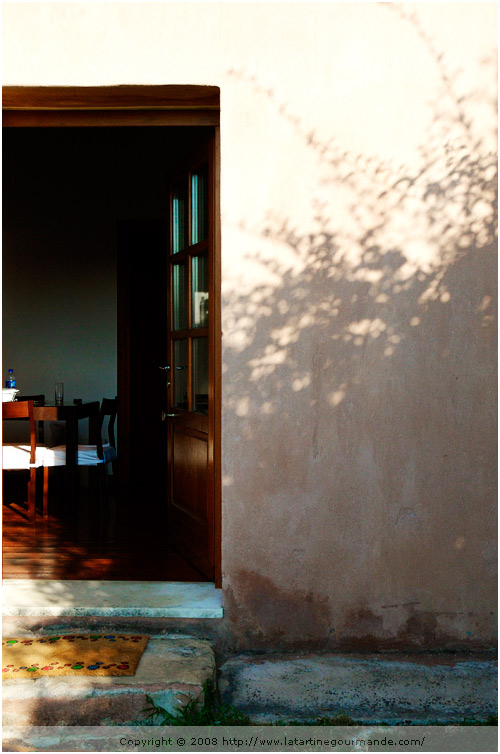
“You will smell olive trees and oregano when you land,” my French friend E. tells me when I tell her about our upcoming trip. Her parents are Greek, but they moved to France when they were still young adults. Talking about Crete with her makes the thought of traveling to the Greek island become real.
By 10 am, it’s already quite hot when we arrive at the small airport of Chania in Crete. I am glad it’s windy too! The road to Maleme, the village where we are staying, is not particularly attractive, and we are far from imagining the lovely spot we find when we finally reach the house we’ve rented for a week.
“Are you sure about the directions?” P. asks, starting to feel a little impatient after we’ve driven for a while as we look for two pink pillars leading to the property. The truth is that breakfast is only now a faint memory: we are getting hungry, beside being eager to refresh with a dip in the pool.
“How would I know? Why don’t we call to check?” I answer, feeling a bit deflated. It’s getting hot in the car too.
But luck is on our side. Just as we are about to give up, we finally discern two pink pillars indeed on the way out of the village. Behind them stands the house, with its lush flowered gardens, and the pool that sparkles like an inviting gem.
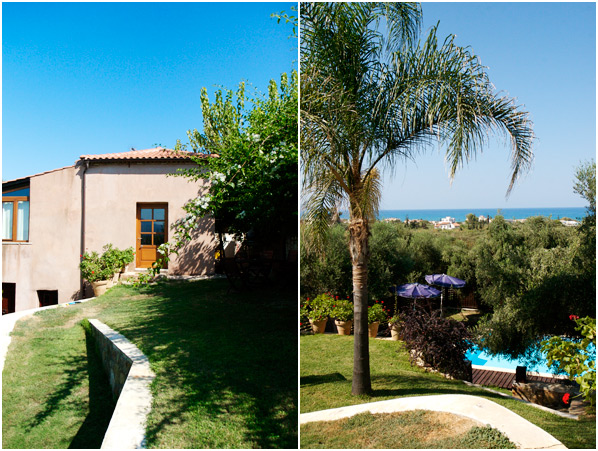
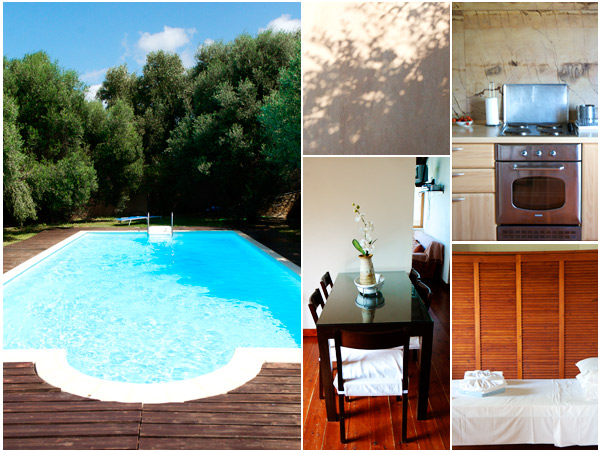
Our rental house is a comfortable and spacious stone villa — once a building where people made wine — with a great pool surrounded by olive trees, a paradise for us who have come to rest. When I first see it, I am beaming with excitement. As I’ve also come with the desire to cook and discover Greek local produce, I am not disappointed either: the kitchen is decorated with taste, meticulously equipped with everything a cook needs. As is in fact the rest of the house.
Our days follow an agreeable routine which we think me might quickly tire of.
But we don’t. Far from it.
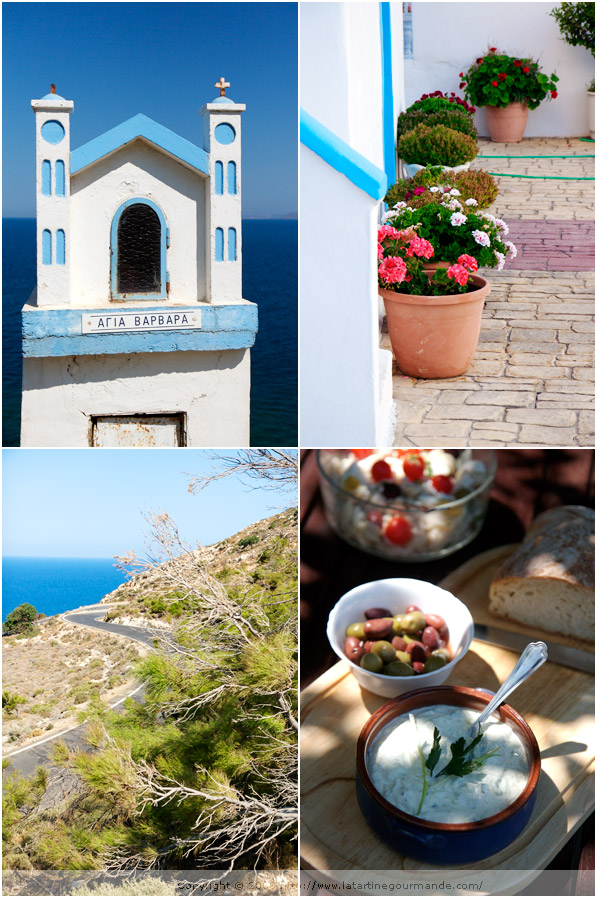
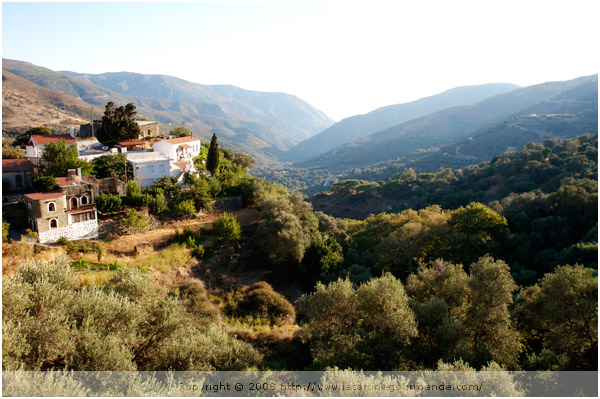
When we are not swimming, playing volley-ball in the pool, or taking long naps lying under the olive trees in one of the many long chairs found in the generously sun-filled garden, we read or chat away, looking at the ocean in the distance. Then, when we do not feel lazy, we take off for a drive to visit the nearby villages, traveling on narrow, winding roads surrounded by majestic mountains, before eventually finishing with a swim that cools us off, when we stop at one of the numerous beaches on the west coast. We prefer to travel short distances because for once, we simply feel this way.
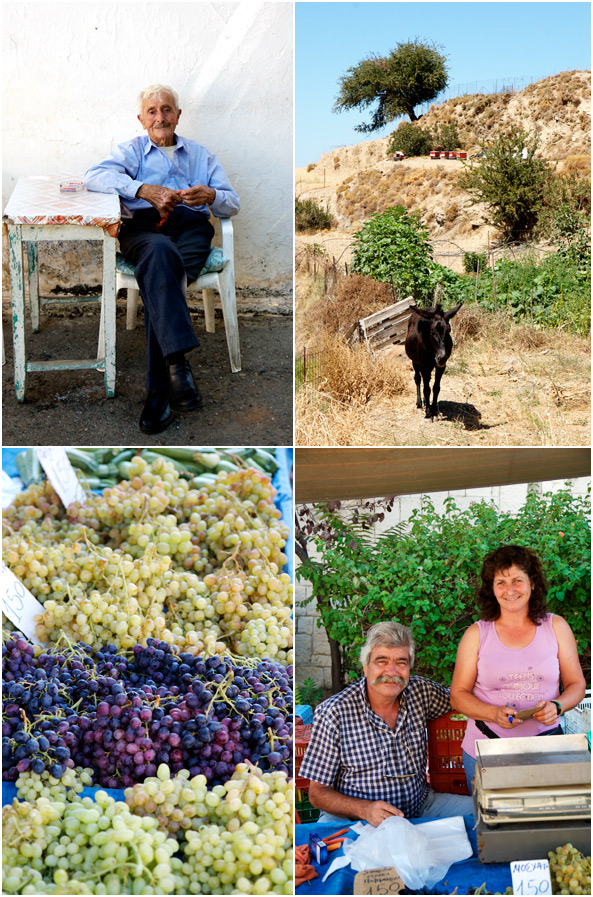
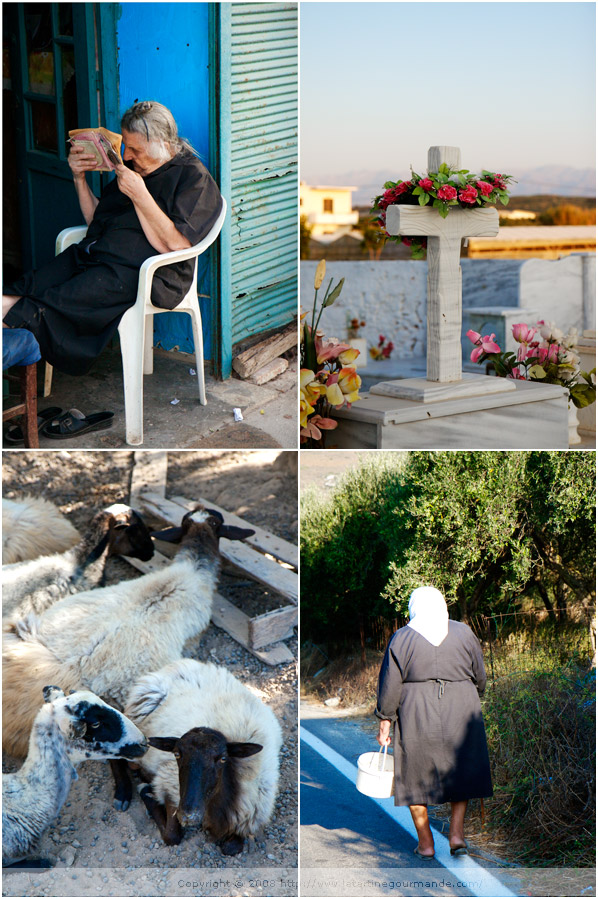
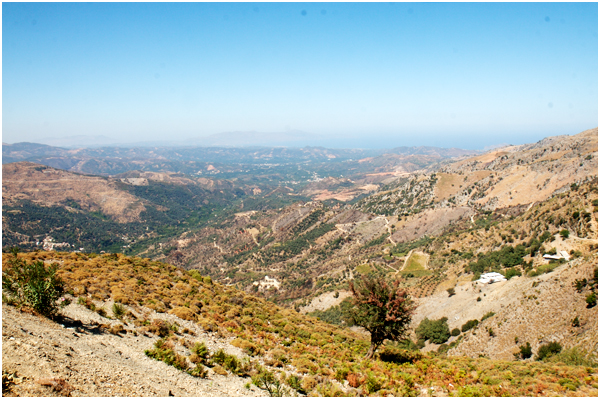
As the biggest of over six thousands Greek islands, Crete stands out as an island full of contrasts. Located at the southern edge of the Aegean Sea, it only takes a thirty-minute flight from Athens before we arrive in this 260 km long island. There, we discover one part largely touched by tourism, with unappealing resorts and hotels, crowds and tourist shops — which we quickly avoid — next to untouched rural areas where life follows a much different pace, slow as one would expect in this part of the world, much closer to what it used to be before tourism left its marks.
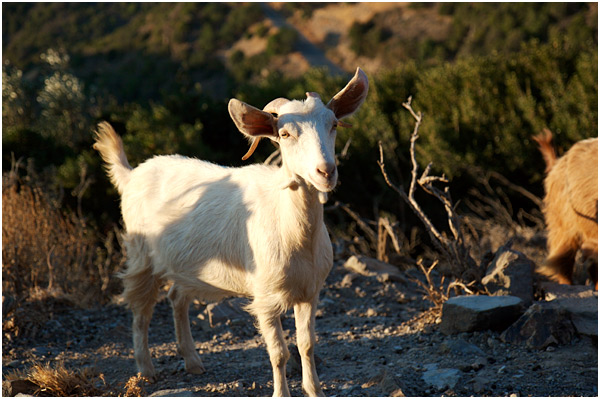
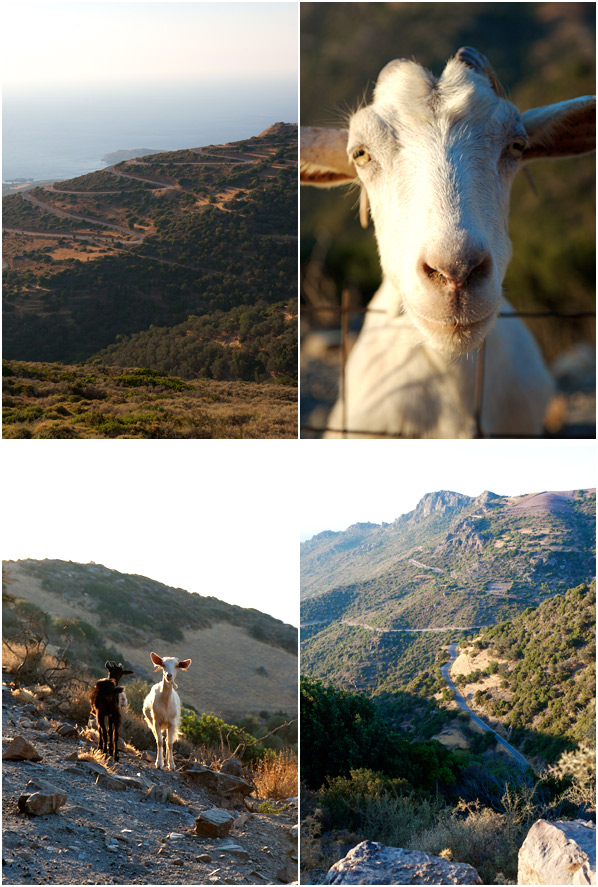
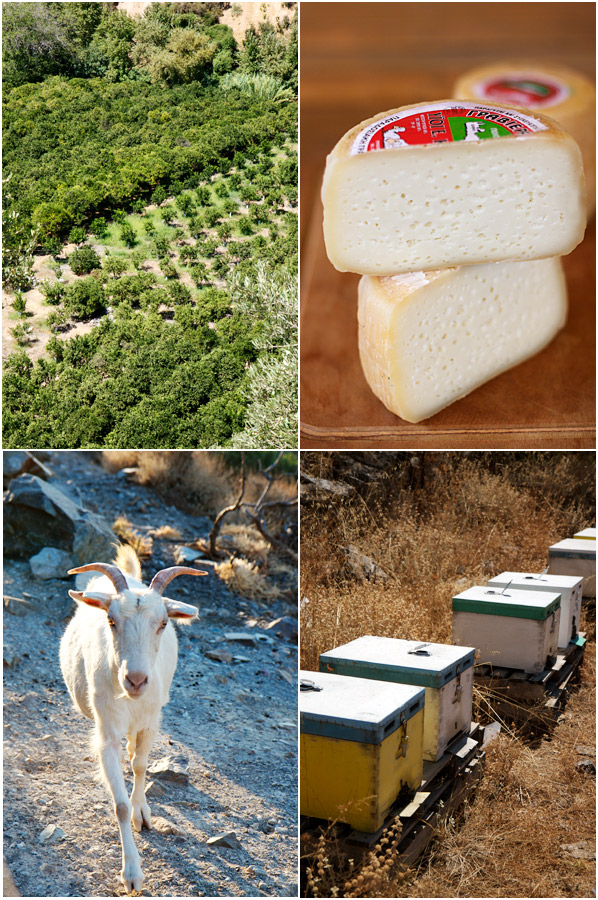
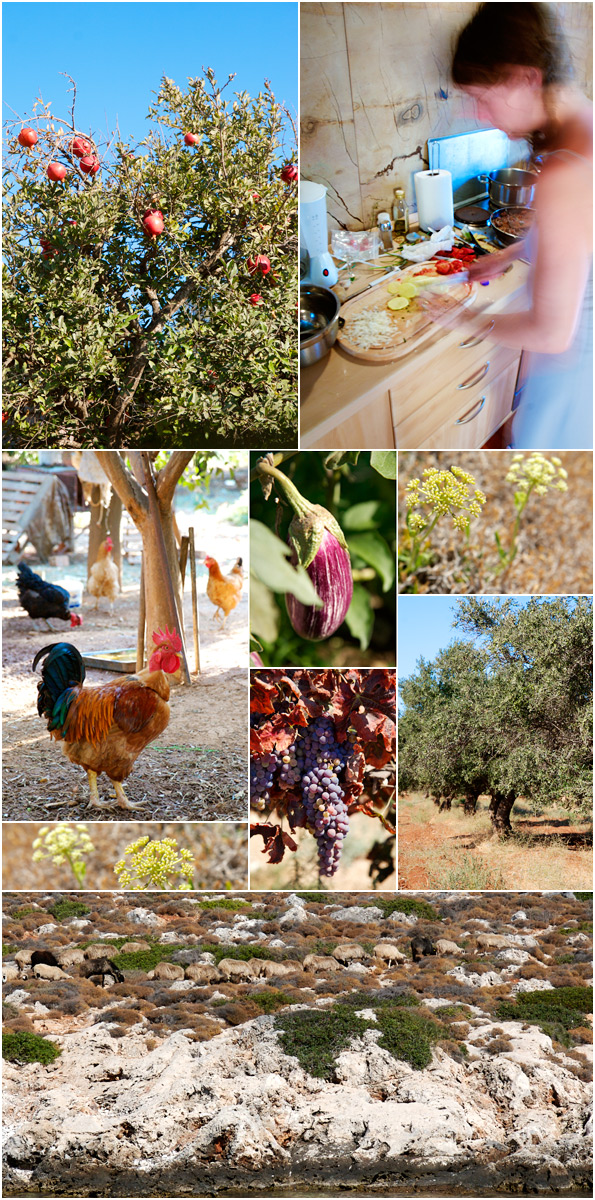
The drives we take through the countryside offer splendid views of rugged ranges of mountains where sheep and goats graze and run freely. Before our eyes unfold mountains which appear dry and arid or, by contrast, richly covered with trees.
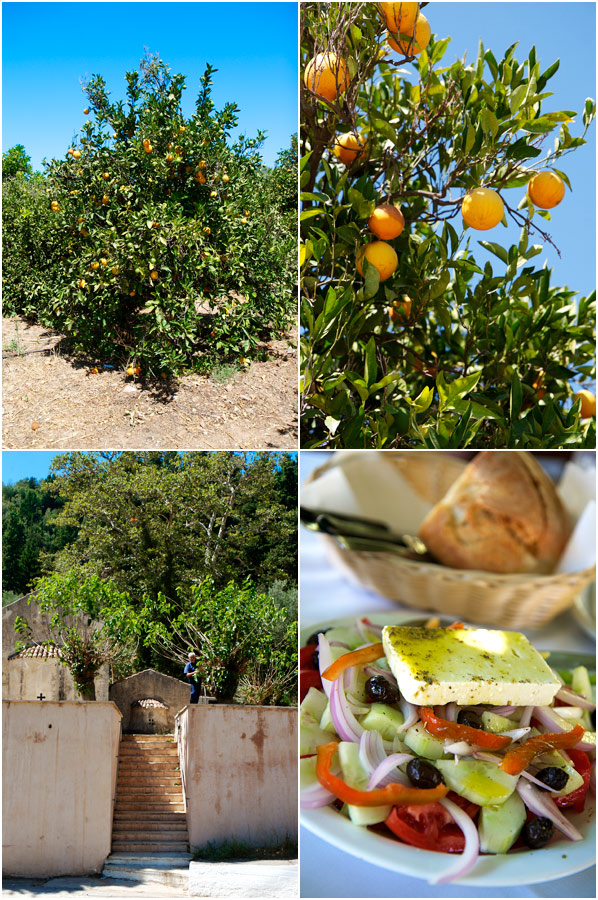
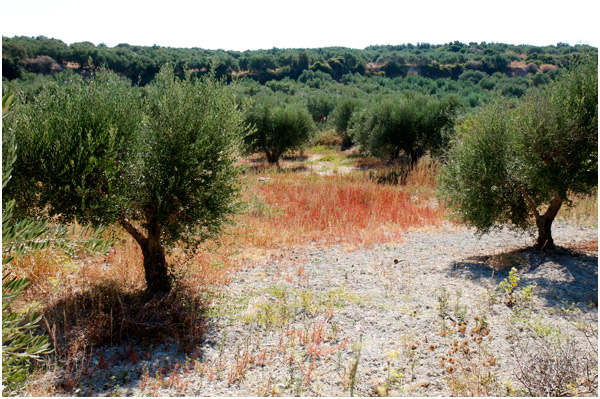
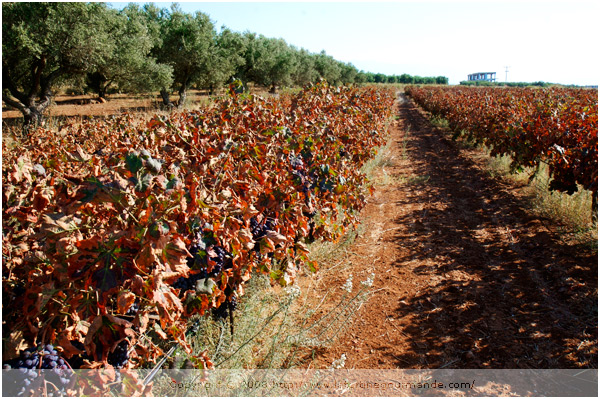
And everywhere, there are olive, orange and lemon trees arranged in straight lines growing in the valleys and villages.
“Look, these are pomegranates,” P. exclaims when we pass one of the villages on our way to Elafonisi island.
I secretly wish I could have a taste of everything. When I go out for walks, I enjoy taking a peak at people’s gardens to see what they grow. Of course, on an island like Crete, zucchinis, eggplants, peppers and tomatoes are vegetables commonly grown. They seem so happy in this environment.
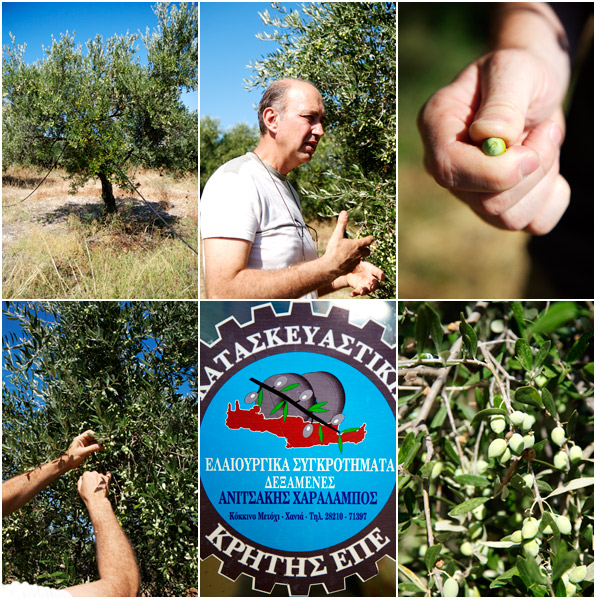
Stefanos, the proprietor of the villa, is a tall friendly man with impeccable English; when we meet him the first time, he welcomes us with a solid hand shake and a genuine smile. To our delight, he likes to tell us stories about the village and his country, and even agrees to take us to the olive oil coop in the village, where he explains the olive oil-making process.
“Everyone in the village has a little bit of land to grow olive trees. Olive oil is a second income for many,” he tells me when I ask if the activity remains widely spread in the village.
The harvest of olive oil starts in November and can last until February. After the olive oil coop tour Stefanos gives us, to explain the machinery used and the system they follow to produce the oil, he drives us aboard his 4×4 outside the village to show us the olive trees, and the irrigation system they use.
“Oh, these black hoses are for water!” both P. and I exclaim, laughing. We are embarrassed to acknowledge that we’ve taken them for electricity cables the first time we notice them.
“How much oil does a household consume a year?” I ask, curious. He tells me that this is the main source of fat they use to cook.
“Probably a hundred liters for a family of four.”
We learn about the different grades of olive oil, from the first press to the following ones. His olive oil is made organically, and has a rich green color pleasing to the eyes. It’s spicy and peppery, giving a wonderful touch to the many salads and the Tzatziki I prepare daily.
You need:
- 2 cups Greek yogurt
- 1 long English cucumber, peeled and grated
- 4 garlic cloves, peeled and crushed (or finely grated)
- Juice of 1/2 lemon, or more according to taste
- 1 Tbsp chopped parsley
- 2 to 3 Tbsp extra virgin olive oil
- Salt and pepper, to taste
Steps:
- In a bowl, mix together all ingredients. Serve fresh, in accompaniment.
Ingrédients :
- 400 g de yaourt grec
- 1 concombre long, pelé et râpé
- 4 gousses d’aïl, pelées et râpées finement
- Jus d’1 demi citron, ou plus selon goût
- 1 càs de persil haché
- 2 à 3 càs d’huile d’olive extra vierge
- Sel et poivre
Etapes :
- Dans un bol, mélangez tous les ingrédients. Servez frais en accompagnement.
Most of the olive oil produced at the village coop is sold to Italian companies, and we are surprised to hear that the buyers are not required to indicate the origin of the oil once they’ve purchased it. I cannot help but then wonder whether the olive oil I regularly buy as Italian is in fact Cretan.
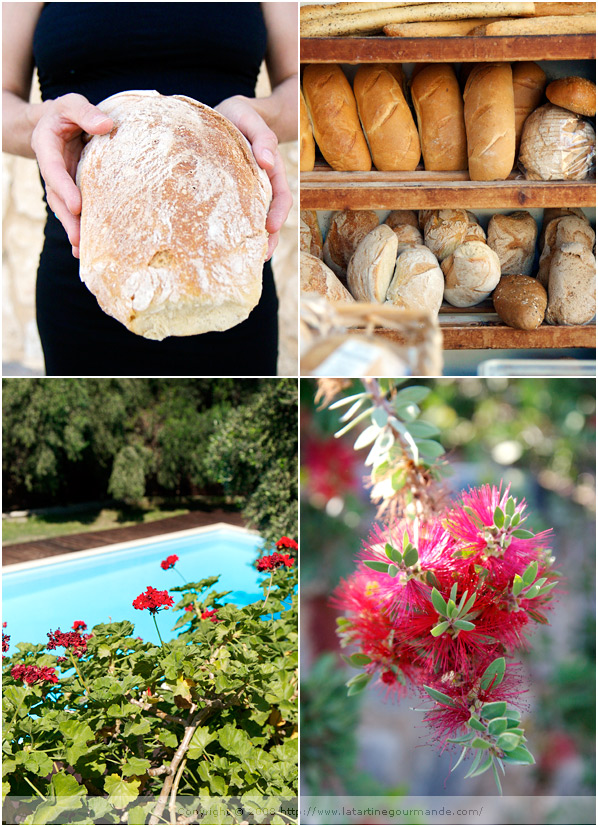
In the mornings, while I set up the breakfast table outside on the patio, P. walks to the nearby bakery to buy a fresh loaf of bread for us.
“This one is called the village bread,” the lady with a tanned face sitting behind the counter tells me on our first visit. She looks surprised when I ask if I can take a few pictures.
“Pictures of the bread?” she exclaims with a puzzled expression. “Sure!”
The bread is rustic, both dense and light; at breakfast, we enjoy it with apricot jam and Greek yogurt drizzled with local honey. Then, later in the day, we have it as a satisfying snack, dipped in olive oil, or feta cheese and tapenade.
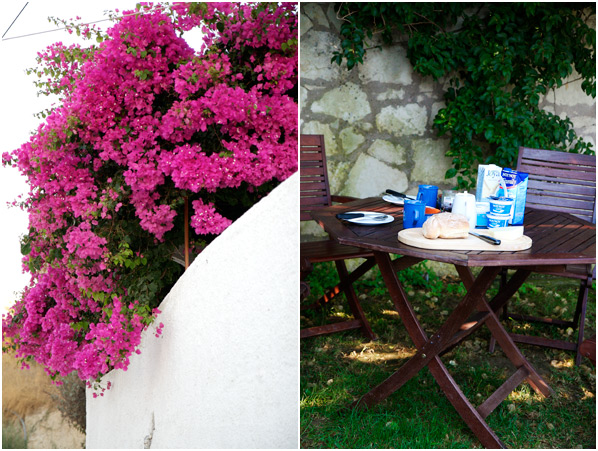
Every day, the weather looks identical: you wake up with the sun, and you go to bed with it!
“Oh, it can be like this until November,” Stefanos tells me, laughing, when I joke about the weather pattern.
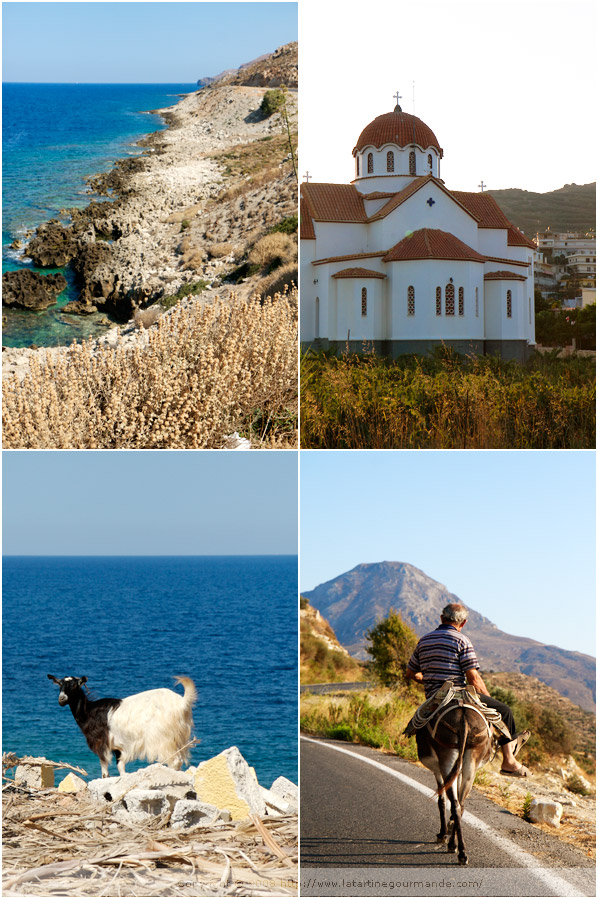
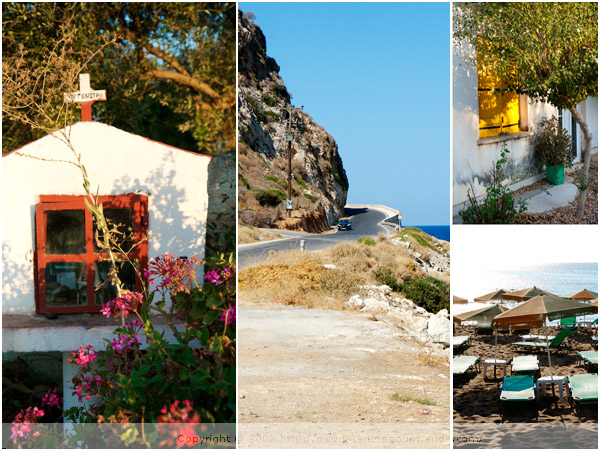
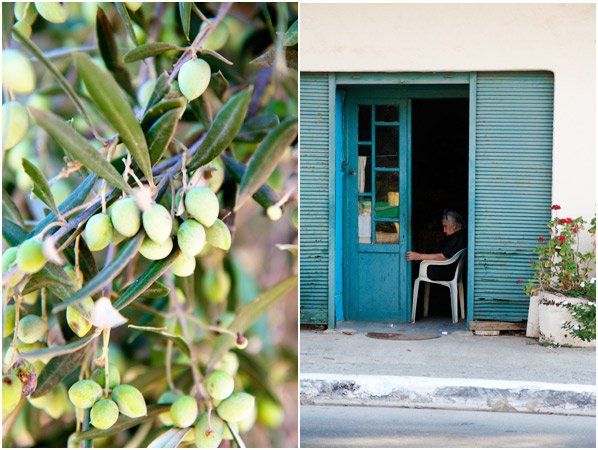
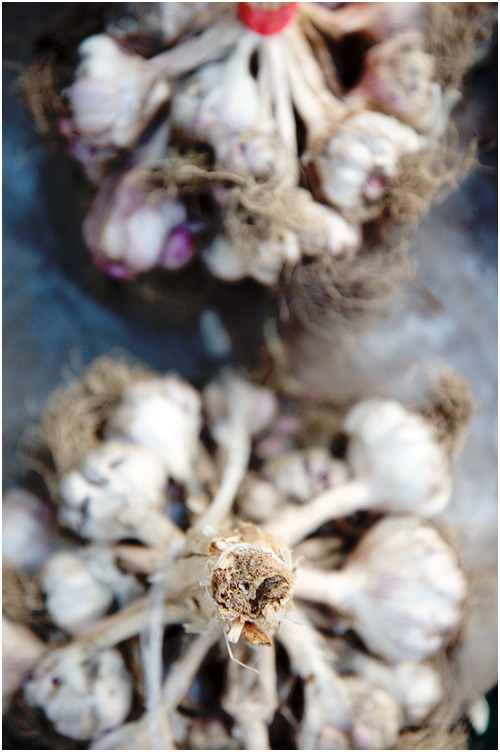
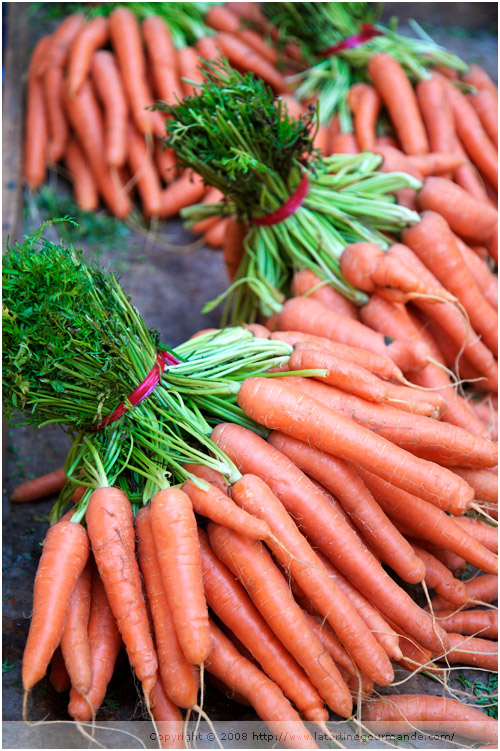
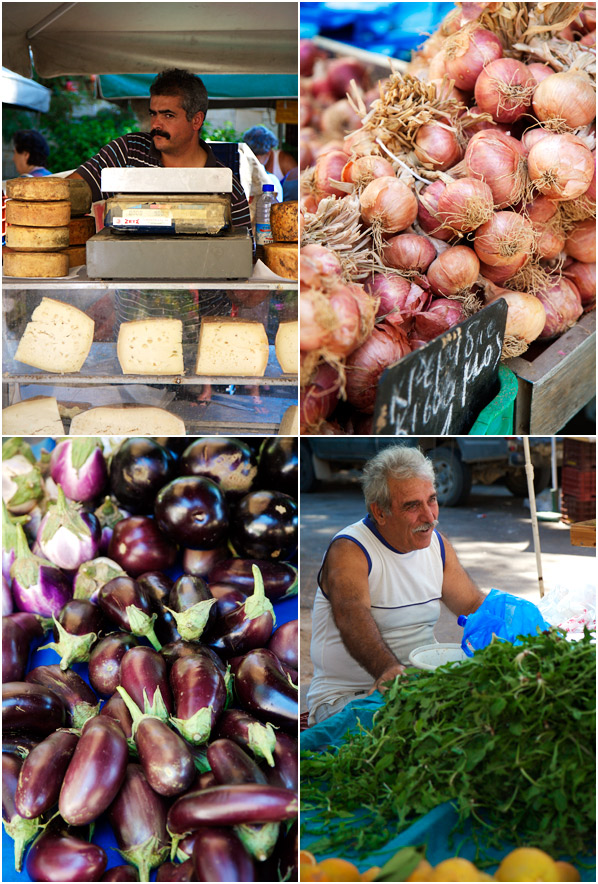
The Saturday open market of Chania (now located by the courthouse) is a favorite time to connect with Cretan local produce. When we arrive at around 11 am, it’s already quite hot and busy on the square. Olives, zucchinis, eggplants, onions, tomatoes, cucumbers are by far the vegetables that the farmers sell the most, but we also find various types of cheese, juicy-looking peaches and grapes, stacks of lavender, a man selling fresh rabbit, displays of whole pieces of fish, and eggs. I am also attracted by the interesting greens I see, quite different from what I know, and the fresh pistachios which I am learning about.
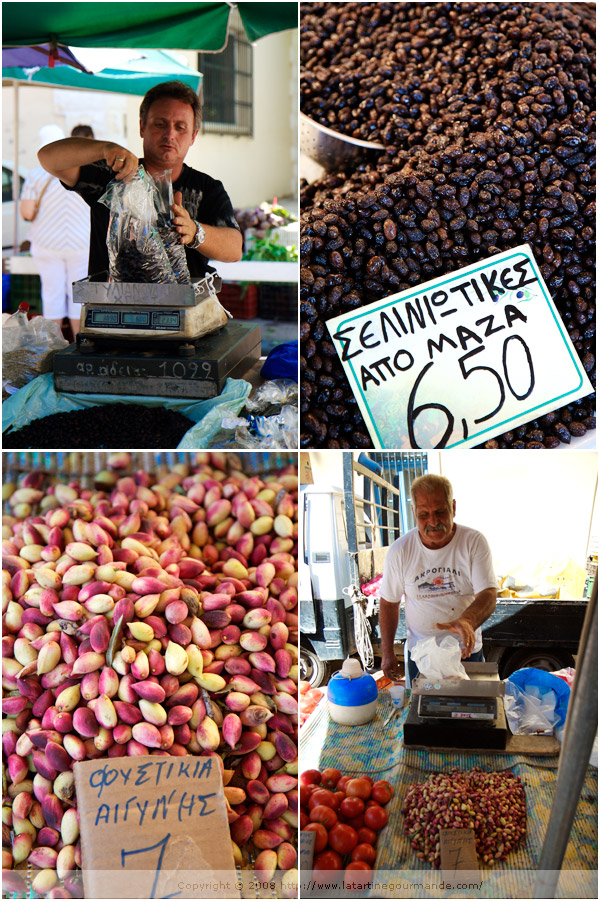
“What is this?” I ask the stocky man with a gray curly mustache standing behind a counter where a high stack of pink-looking beans are loosely arranged. He looks back at me and smiles. It’s obvious that I won’t understand his Greek, and him my English. So to explain, he picks a bean between his fingers, removes the outer soft shell skilfully with only one hand, and holds the pistachio in its hard shell back to me.
“Here!” he tells me, convinced that I can now guess what it is.
“It tastes just like a walnut when it is open fresh,” I whisper into P.’s ear after I take a small bite.
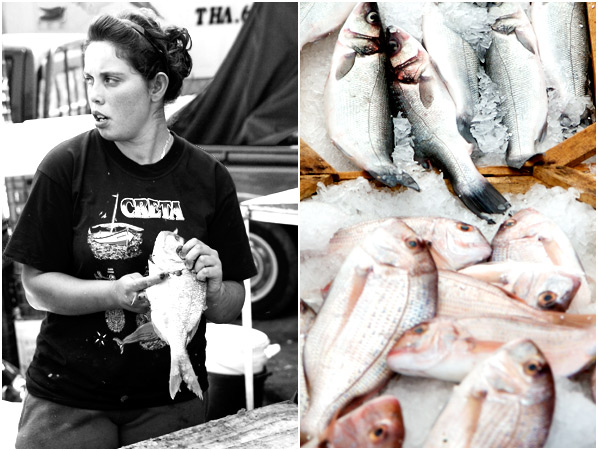
We return home with a large bag full of fresh vegetables and fruit, and two pieces of whole fish that I am planning to grill in the evening. P. chooses the pieces. The young woman at the fish counter cleans them skilfully, without even looking at what her hands are doing.
We are excited to have found fresh fish because on the island, we soon find out that paradoxically, a lot of restaurants and tavernas serve mostly frozen fish. The mystery as to why remains.
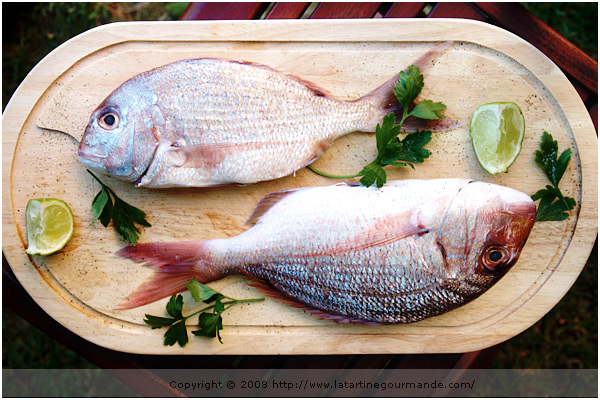
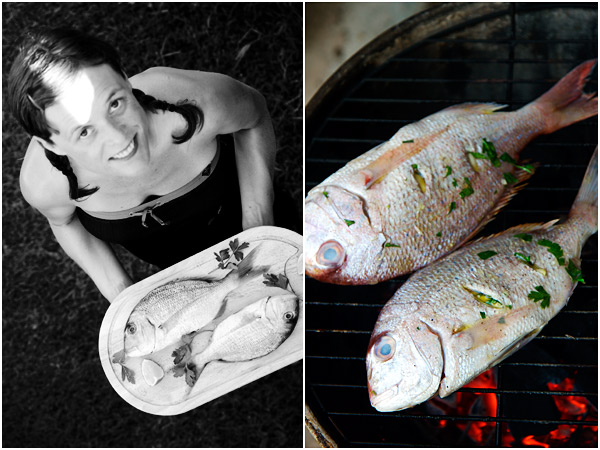 Grilling Fish
The beaches in Crete are all different in style. We decide to visit only a few — the pool is quite convenient, and tranquil, I must say: from Stavros located on a peninsula east of Chania (a beautiful little bay with the Zorba mountain as a backdrop, the setting used in the movie Zorba the Greek), to Falassarna and Elafonisi, on the west coast.
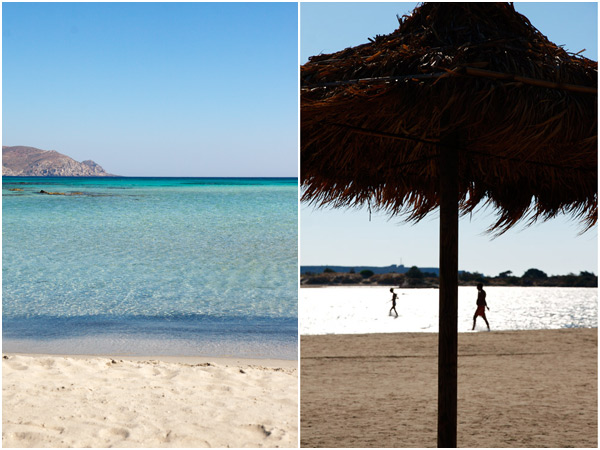
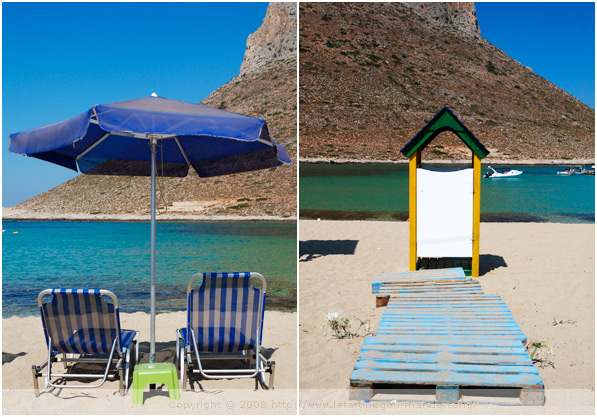
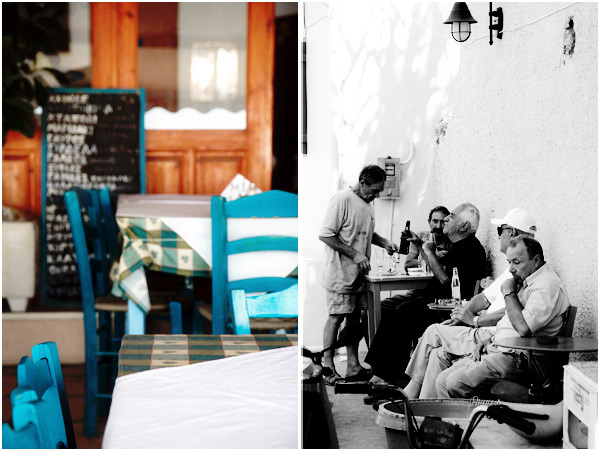
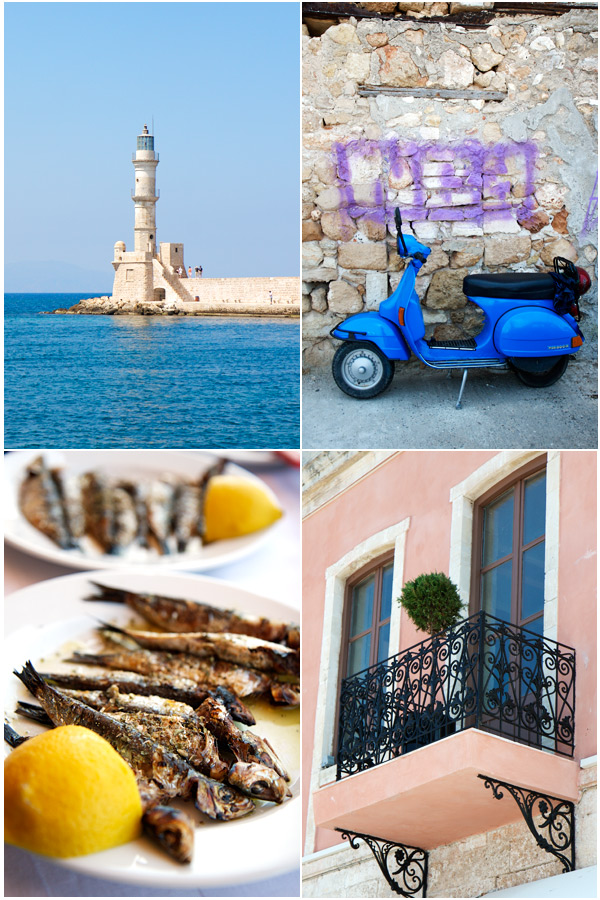
During our stay, when we dine or have lunch out, we eat in tavernas where the food is down-to-earth and unpretentious, and always extremely fresh. Amongst the dishes we enjoy, there are tasteful olives of all flavors, the unmissable Greek salad, moussaka, stuffed vegetables, stuffed wine leaves, grilled sardines and octopus, Saganaki (fried Graviera cheese), fried zucchinis, shrimp slouvaki, plain yogurt and honey, and to finish, always a slice of complimentary watermelon or melon coming with the bill. Every vegetable tastes like it’s been basked in the sun for hours, giving the best summer has to offer in your plate.
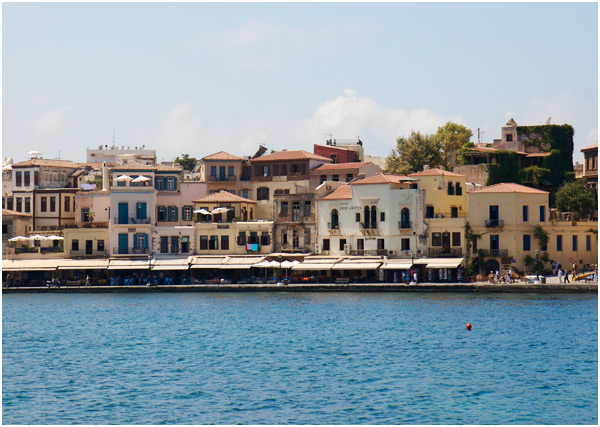 Venetian Harbor in Chania
One morning, we decide to drive to Chania to stroll along its picturesque Venetian Harbor Port. The place is busy with tourists, tavernas and cafés, but it manages to keep an authentic charm with its historic buildings.
“In fact, it’s perhaps what the island used to look like years ago, minus the restaurants,” Stefanos tells us when we ask him about the port. We soon find out that like in Athens, Cretans do not seem to mind building modern in the middle of more ancient. So keeping a place like this harbor is a must. That day, we enjoy a tasty lunch made of simple, honest food, as we sit at the table of one of the many tavernas by the water.
It’s unusual of us to plonk ourselves in one place for an entire week. Instead, we typically long to cover distances to see as much as we can. But this time feels different. This time, we need to slow down too.
And we are happy.
We have a relaxing and quiet vacation. Perhaps because the house is so comfortable, perhaps because we enjoy many of the pleasures of life we are fond of, like swimming, observing Nature, reading, strolling and cooking. Simply taking the time to do nothing and follow a slow pace.
So when we eventually leave Crete, we have a load of fantastic memories in our luggage, with the desire to come back to see much more, including hike the gorges of Samaria.
A last visit to a local produce store allows me to buy two kilos of olive oil flavored Graviera cheese (made of a blend of sheep and goat milk, like all cheeses made on the island) that I bring to my parents and my brother B.; a decorative deep blue plate from a local potter; and a few bottles of organic extra virgin olive oil.
And in my head, I have plenty of recipes enjoyed during our vacation, that I am keen to reproduce at home, as soon as I find my kitchen back.
 Making Moussaka on vacation
“Qu’est-ce tu fais à manger ce soir ? (What are you cooking tonight?) ” I ask my mum when she and I are at the supermarket. I’ve been in France for almost a week, but still have a strong taste for summer vegetables. I am craving sun-filled tomatoes, zucchinis and eggplants.
“Je n’sais pas encore. T’as des idées ? (Not sure yet. Any suggestions?) ”
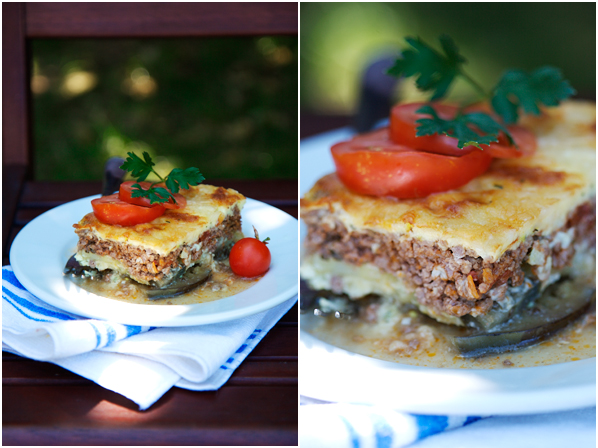
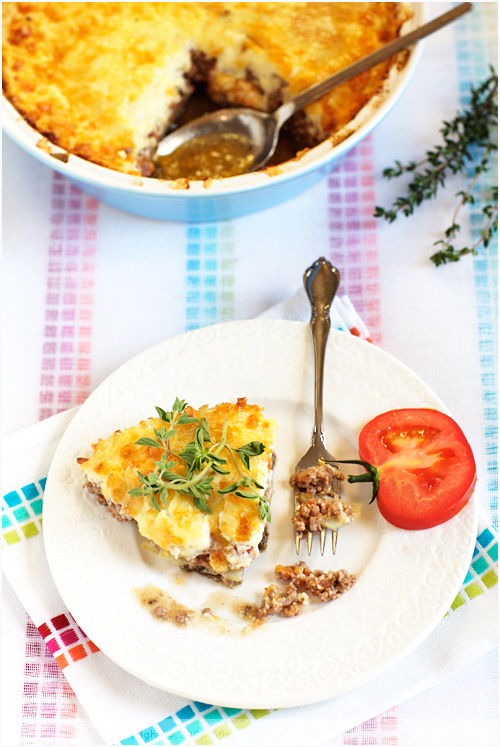
“Et si je faisais de la moussaka, comme celle que P. et moi on a mangée en Crète ? (Shall I make a moussaka like the one P. and I had in Crete?)”
“Bonne idée !” she exclaims. We will use the tomatoes, onions, oregano and eggplants from her garden, the best.
I am thrilled.
To cook it, and share a taste of our sunny vacation with my family.
You need:
- 2 pounds ground lamb
- 6 to 7 tomatoes (2 pounds)
- 2 medium-sized eggplants (1 pound)
- 1 large Yukon potato (10.5 oz)
- 1/4 cup white wine
- 3 cups whole milk
- 5 Tbsp butter
- 1/3 cup cornstarch
- 1 egg
- 3.5 oz Greek graviera cheese, grated (or any sheep milk hard cheese)
- 1 Tbsp chopped fresh oregano
- 1 thyme twig
- 1 bay leaf
- 1/4 tsp ground cinnamon
- 1 yellow onion
- 1 garlic clove
- Salt and pepper, to taste
Steps:
- Wash and slice the eggplants. Place them in a colander and sprinkle with 1 tsp salt. Toss and let rest for 30 minutes. Pat the eggplant slices dry; set aside.
- To prepare the meat and tomatoes, start with blanching the tomatoes in boiling water for 1 minute, then rinse them under cold water. Peel and remove the seeds. Dice the tomatoes and set aside.
- In a saute pan, heat 2 tablespoons of olive oil on medium heat, and cook the onion until soft. After five minutes, or when the onion is soft, add the garlic and continue to cook for 1 min to reveal the flavor.
- Add the meat and cook until all the meat grains separate (takes about 6 to 7 minutes).
- Then add the white wine, and cook until slightly evaporated.
- Then add the tomatoes, the bay leaf, oregano, thyme and cinnamon, and stir. Bring to a gentle simmer, then reduce and simmer for about 1 hour uncovered, stirring occasionally and mashing the tomatoes with the back of a wooden spoon. Season with salt and pepper. Once cooked, discard the thyme and bay leaf.
- In the meantime prepare the white sauce. In a pot, melt the butter on medium heat. Add the cornstarch and stir well. Away from the heat, pour the milk and stir. Bring the sauce to a boil while stirring. Once it boils, it should thicken; cook for 1 to 2 minutes. Season with salt and pepper, and add 1/3 cup cheese. Let cool before adding the egg.
- Preheat your oven at 350 F.
- Peel the potato and slice thinly; set aside.
- Brush the bottom of a large rectangular gratin dish with olive oil.
- Arrange the eggplants at the bottom, then top with the slices of potatoes.
- Add 1/3 cup of the white sauce, then top with the meat sauce.
- Finish with the rest of the white sauce and cover with grated cheese. Cook in the oven for about 1 hour, or until the top is golden in color. Enjoy with a green salad. It is even better the second day!
Ingrédients :
- 900 g d’agneau haché
- 6 à 7 tomates (environ 1 kg)
- 2 aubergines de taille moyenne (environ 450 g)
- 1 grosse pomme de terre à chair ferme (300 g)
- 60 ml de vin blanc
- 700 ml de lait entier
- 75 g de beurre
- 50 g de maïzena
- 1 oeuf
- 100 g de fromage grec graviera, râpé (ou tout autre fromage à pâte dure au lait de brebis, comme le Petit Basque)
- 1 càs d’origan frais haché
- 1 brin de thym
- 1 feuille de laurier
- 1/4 càc de cannelle en poudre
- 1 oignon, haché
- 1 gousse d’aïl, râpée finement
- Sel et poivre
Etapes :
- Lavez les aubergines, et coupez-les en tranches. Mettez-les dans une passoire et saupoudrez-les avec 1 càc de sel. Mélangez et laissez dégorger pendant 30 minutes. Sèchez-les sur du papier absorbant, puis mettez-les de côté.
- Pour préparer la viande et les tomates, commencez par blanchir les tomates dans un grand volume d’eau bouillante salée pendant 1 minute, puis rinsez-les sous de l’eau froide. Pelez-les et retirez les graines. Coupez les tomates en dés; réservez.
- Dans une sauteuse, faites chauffer 2 càs d’huile d’olive sur feu moyen, et faites suer l’oignon pendant 5 minutes. Ajoutez ensuite l’aïl et poursuivez la cuisson pendant 1 minute.
- Ajoutez la viande, et cuisez en vous assurant de bien séparer les grains de la viande (environ 6 à 7 minutes).
- Ajoutez le vin et faites légèrement évaporer.
- Ajoutez les tomates, la feuille de laurier, l’origan, le thym et la cannelle et mélangez. Faites mijoter à découvert pendant 1 heure environ, en remuant de temps en temps et en écrasant les tomates avec le dos d’une cuiller en bois. Salez et poivrez. Une fois la sauce cuite, retirez la feuille de laurier , et le brin de thym.
- En attendant, préparez la béchamel. Dans une casserole, faites fondre le beurre. Ajoutez la maïzena, puis hors du feu, ajoutez le lait. Mélangez et faites bouillir; la sauce va épaissir. Cuisez pendant 1 à 2 minutes. Ajoutez 30 g de fromage râpé. Une fois refroidie, rectifiez l’assaisonmment, ajoutez l’oeuf.
- Préhauffez votre four à 180 C.
- Pelez les pommes de terre et coupez-les en tranches fines.
- Huilez un plat à gratin rectangulaire.
- Arrangez les tranches d’aubergine au fond, puis continuez avec une couche, ou deux, de pommes de terre.
- Ajoutez quelques cuillers à soupe de béchamel, puis couvrez avec la viande en sauce.
- Finissez par le reste de béchamel et couvrez de fromage râpé. Cuisez au four pendant 1 heure, ou jusqu’à ce que le dessus soit bien doré. Dégustez avec une belle salade verte. Le plat est encore meilleur le lendemain !
Beautiful Bea…Absolutely beautiful. I love the photo of the lady who tried to read the book.
Picture worth lots more then words!
You always make me want to get on a plane and go so where. Beautiful as always.
Bea~ ths a lot~
so many beautiful photos and so many yummy~
Wow! Thank you so much for sharing your experience. This place looks amazing and your pictures (more amazing than ever) really draw you in. I wish I could spend a while there and slow down…
And thank you for the Moussaka recipe 🙂 Very appropriate!
Superbes photos qui me rappellent beaucoup de souvenirs.. merci !
Comme ces magnifiques photos ravivent en moi de beaux souvenirs….la Crète si sauvage et paisible!….
Et sa fameuse salade, ma favorite parmi toute, dégustée sous la tonelle d’une taverne!
Ton billet est superbe!
fabulous diary
How wonderful Bea, this brings back such happy memories of our holiday in Crete about eight years ago. It looks like it hasn’t changed much at all!
I’m sure I recognise the little white church with the coloured window panes. And Chania, of course. We also stayed one night in a really tiny village with spectacular views up in the mountains, but for the life of me I can’t remember the name of it!
Such a beautiful post…fabulous photos. Reminds me of when we went to Crete, a few years ago!!
Your pictures are great. Thanks for sharing your travels.
http://www.foodista.com
Such a beautiful place! Your pictures are magnificent!
Two delicious recipes! When I went to Greece, I ate Moussaka at least three times a week ;-P…
Cheers,
Rosa
Bea, when I heard you were off to Greece, I knew you would love it. Greece (along with Italy) is my favorite destination. I’ve been there often and always come back feeling elated like a little trip to heaven. The food, people, culture is all so wonderful – so, from what I can make out about you from your blog I kind of knew you would like it there. Thanks for sending us to heaven with this lovely travelogue!
what a beautiful place! thank you for sharing it with me.
J’adore les photos e le recettes. Merci!
Your numerous talents never stop to amaze me.
Tes photos sont comme toujours sublimes…j’ai l’impression de retourner en Crète…mais ne plus beau!
I just came back from Crete!!! It’s nice to see again this wonderful atmosphere!!!! Very nice pictures! Ciao! Silvia
Beatiful picuture, as always! I love Your blog and I would like make so amazing photos like You!
Wow ! Des photos magnifiques qui rendent si bien la lumière et les couleurs de ce pays ! Un peu de nostalgie en les voyant, même si je n’ai jamais fait la Crête…
Merci de partager ce voyage !
oh my! what a wonderful trip, beautiful photos, stunning recollection of details, recipes… this was amazing bea!
You photos are amazing …like you brought me to Crete! How I wish…someday! Thanks for the recipes…this post reminded me to eat more veggies!
Really really really a beautifull post!! Thanks Béa!! 🙂
I could just imagine all the beauty and warm breezes – thanks for sharing your vacation with us!
A perfect tale of a fabulous vacation. You’ve inspired me to visit Crete and to make this moussaka. Thank you.
Bea…Absolutely beautiful. I love your blog, photos and recipes. I have a very good french artist friend Patricia that just moved to Crete with her musicien friend Didier. If you’re in their neighborhood she would be delighted! Here’s their site : http://www.crete-evasion.com/. Happy vacationning!
Just ab. fab!!! So beautiful. Hope to use your advise next summer.
these images are amazing. i love the scenery and how food is the great unifier. it makes it feel like home.
Quelles images fantastiques!! Je me suis regalee! Quelles couleurs! Quel oeil! Superbe!!
What a dream of a vacation! Your photos always take me away!
Tu me remémores de délicieuses vacances. La salade grecque est toujours meilleure là-bas, ici la feta n’a pas le même goût.
Really beautiful post Béa. It’s what makes La Tartine Gourmande so wonderful – travel writing, photography, food and recipes. I love eggplant and I’m a bit embarrassed to admit that up until yesterday I’ve never had “garden fresh”, only store-bought from who-knows-where. Such a difference! We had some last night fried in olive oil with potatoes and red peppers. Delicious! Today the remaining eggplants will become moussaka, with your help. Thanks again for the wonderful recipes.
Holy crap, you’re a fabulous photographer!
Oooooh Crete, I used to live there for years, like ages ago 😀 I LOVE LOVE LOVE the place, thanks you sooooo much for the pics!!!!
ce n’est pas un billet mais un livre…et c’est photos…presque mieux que la réalité 😉 biz
Mon Dieu…. quelles photos ! C’est plus que ça, un reportage complet et vivant. Vraiment très beau, énorme merci pour ce bon moment
how beautiful…I feel like I was there ….I am making your apple cake now
wow what a beautiful post, wish I could go see all this in person
oh my… Greece is somewhere I’ve been longing to go for years. I made your seasonal apple upside-down cake yesterday, and it got great reviews! Unfortunately, I didn’t get to try it myself, since I sent it with a friend to a birthday party that I was going to be late for, and by the time I got there, it was gone! Thank you for the beautiful post and recipes.
Your pictures are just fantastic – wow! I can’t stop looking at all the beautiful scenery. And your descriptions, to go along with them, are wonderful. I feel like I’ve just been given a guided tour through Crete. Thanks!!
Un grand merci pour ces belles images et la recette de la moussaka.
What a wonderful holiday… sunny, healthy and restorative. Your pictures are beautiful and the dishes you had there look yummy. I love Moussaka, now I want to bake some 🙂
The 5 millionth !wow! 😀 Incredibly delicious photos. You look wonderfully happy.
FYI: fish is frozen to kill the parasites they inevitably carry. (I know, ick, but still much tastier and healthier than farmed fish, so… please don’t *kill* the messenger!) I live in a beach town and it is done here as well.
merci pour ce voyage virtuel ! j’aime beaucoup ces paysages mediterannens !
IWhat a lovely vacation. Thank you for sharing it with us!
Beautiful pics and writing. You describe so well some of my memories of our experience of Crete this July and that I still carry in my mind and heart!
thank you!
Oh cette envie de soleil et de chaleur que tu me donnes!
Oh, I feel like I’ve been to Crete now.. The goats! The sheep! The cheese! The olives! Except I can’t smell it, and I bet that the aroma is the most important part. Thanks for sharing, so beautiful.
Génial de te voir cuisiner Béa !
Great to see you cooking Béa !
:))))))))))))))))
Merci Bea! Tu me fais rever!!
Il me semble que vous avez passé de belles vacances 🙂 les photos sont magnifiques !
Made my day beautiful and peaceful here on a Monday morning in Ottawa, Canada. Thank you for blessing me. So many pictures!
bravo ! quel merveilleux reportage ! la maison avait l’air aussi parfaite que la Crête, et c’est en effet, une bonne idée de louer et de vivre comme les gens du pays.
Bea
The photos were amazing! I am trying to get our home to follow a Mediterranean Diet kind of life, so this was very inspiring.
What gorgeous photos- I almost feel like I traveled there myself! I wish I could live in such a peaceful and beautiful place. Will definitely try the recipe as well.
Pingback: bostontparties.com » BoTalks
Beautiful photos!
Le pied!
A Very excellent presentation of Crete. The photos are great and the article so good I could almost taste and see the food as I read about it. Also it brought back many memories of our last trip to Chania. However there are many other parts of crete that are great too.
You have such an incredible eye for photography. Everytime I come here, I am totally whisked away to where you have been. Amazing! Well done!
Magnifique!
Beautiful! Your photos take me away….. Thank you 🙂
Oh you are quite something! Many many thanks for your generous comments. I hope you have the chance to visit one day, if you have not yet not done so!
Pingback: Le Carrefour » Poulet farci au parmesan et aux noix de pécan
I love your photos too, and how you captured the sun, the charm of the place, the food and the people, giving us the best picture of Greece. And loved the moussaka recipe, which is almost like what we had here at the Greek festival and the taverna across the street from St. Sophia Cathedral. I cannot wait to post my grandma’s moussaka’s recipe, the Romanian version is a little bit different, or at least hers was.
i would love to make the moussaka bea but being a vegetarian what would you reccomend as a good substitute for the meat.
Bea, love everything about this post. you have a beautiful way of looking at the world and we can see it in your pictures.
Very nice post! I spent a semester in college in Greece (well, 1/2 a semester) and visited Crete. I’ve always wanted to go back.. this provided for a nice trip down memory lane over lunch. Great photos… I really want to visit that Villa some day! Very nice!
Bea, i am back one more time, i finally posted my grandma’s recipe, the way we make it http://roxanasculinaryblog.blogspot.com/2008/10/my-grandmas-moussaka-musaca-reteta.html. I don’t know if the changes were due to some memory loss from Greece to Romania, but it’s still from the Balkans.
Wat a wonderful holiday. We have been talking about going over there, I will definitely have to use your suggestions. Renting a house is the way to go, we do that in Paris when we go & it is great to live like the locals. Your photos are fantastic … I feel like I am sitting there now! Taking me away from the debates!
Thank you for taking me along on this lovely trip 🙂 I enjoyed every minute of it.
Merci pour cette superbe recette de moussaka. J’en ai fait la semaine dernière et le résultat était parfait.
Thank everyone, once again!
Nathalie, merci. J’en suis super contente !
Quelles magnifiques photos qui me rappellent la douceur de ma Méditerranée et qui sont à elles seules une invitation au voyage, pleines de saveurs et de senteurs! Hmmm, des dorades royales ! Très surprenant le mystère du poisson congélé, je vais me pencher sur la question… Dès que j’ai des invités, j’essaie ta recette (je mangerai la partie patate/béchamelle ;-)) mais je sais par avance que ce sera délicieux.
Béa, what camera do you use to capture these amazing picture? The close-ups are impressive. Superbes photos. Mes compliments.
Hope to get your reply. Thanks, Merci. Karine
Merci pour cettte recette revisité de la moussaka!
Même ma petite soeur a aimé alors qu’elle n’aime pas les aubergines
Your photographs always manage to capture all 5 of the senses. I can smell, see, hear, feel and taste Greece!
Pingback: The story of the berry Pavlova — L’histoire du pavlova aux fruits rouges | La Tartine Gourmande
How beautiful…you really have shown the heart of Crete…your pictures are a tribute to your eye for the authentic and the taste for fresh food…We love Crete too!
Katia and Anastasi
Pingback: EasyTomatoes.com » Blog Archive » Tips to Organize Your Kitchen on a Budget
I was helping a neighbor bake a cake and knew that we would starve from the smell of it if I didn’t bring some form of sustinence… so I brought your mousaka! It was wonderful wonderful wonderful, and successfully kept all cake cravings at bay! Thanks again, your recipes always work like a charm!
What a wonderful feature, it so reminds me of my many trips to Greece and is making my mouth water for my trip to Crete in September!
Traveling is great to get inspiration for new recipes, your pictures and of course recipes are beautiful. Local grown fresh products are so full of flavor you don’t need much more. After reading this post I would love to fly to Crete right away (especially because it is snowing here like crazy)
This has to be the most mesmerizing post I’ve ever gone through! Extremely beautiful photography. I LOVE it!! Thanks!
Pingback: Oh Wow … « CONFETTI
Superior blog, I feel it is nice when individuals specific their positions as vehemently as you have. Technique to present your faculty delight! Make us proud!
This looks like a great recipe! I’m going to give it a try at my next dinner party for a friend who loves this dish, and I’ll let you know how it goes on my blog!
After reading your article I spent my holidays in this hotel http://www.minos-beach-art-hotel.com.
Crete is amazing and your photos are fantastic
Pingback: Inaugural Cookout 2011
Beautiful! Your photos take me away….. Thank you 🙂