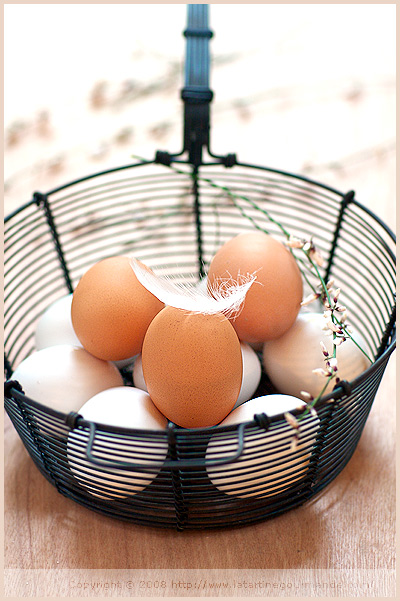
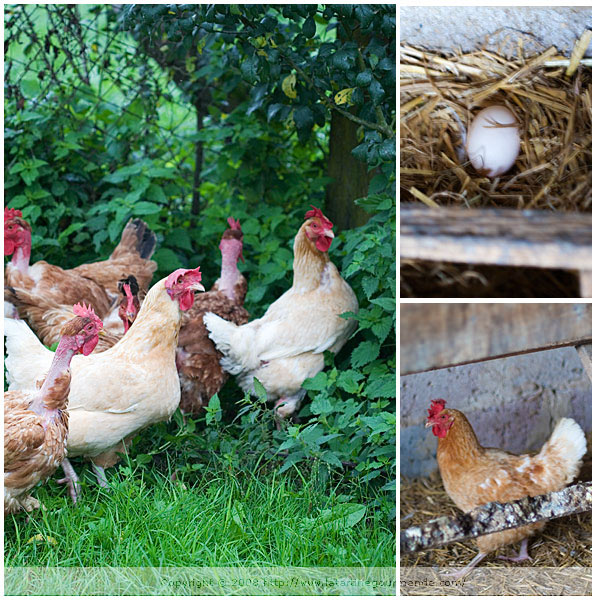
There are privileges that I wish I could have kept from my happy upbringing in rural France. Take for example eggs. Would you have dreamed of anything better but collect eggs still warm, with feathers — and dirt — stuck to them, from the poulailler (chicken house)?
“Tu les laisses pour moi hein, dis mémé !” (leave them for me grand-ma!) I used to tell my grand-mother before my parents drove us to their farm, a few kilometers away. My brother B. was older and clearly less interested in those farm-like games. So mémé invariably did leave the eggs for me to collect. She and I would then walk to the large garden she kept impeccable at the back of their big house; we would feed the rabbits together and on the way back, we would dig out a salad and some vegetables for dinner. I would carry the basket full of our treasures; staying over for a meal was nearly always happening. A good thing since it meant tasting my grandmother’s saucisson, the best I’ve ever eaten to this day. I loved to be at the farm. And I loved to collect the eggs.
So perhaps like many people, I could worry about my consumption of eggs. Clearly they are a staple ingredient in my cooking. I use them in flans, clafoutis, cakes, omelets, custard, oeufs en cocotte: the possibilities are endless. But in truth, I have never worried about eating too many eggs. And I do not think that I ever will.
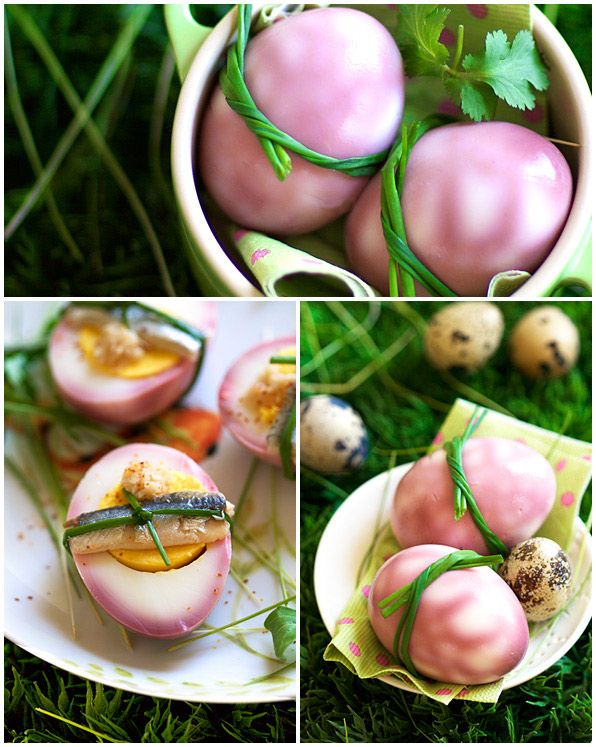
When I am working at home — or when P. and I go hiking or decide to picnic somewhere green and sunny — one of my favorite daily snacks is a hard-boiled egg sprinkled with a dash of fleur de sel, and a touch of preserved horseradish if I have any in the fridge. Aren’t they wonderful food?
My dad often tells me that he used to eat hard-boiled eggs as a snack on the farm when he was young. I suspect that he’s passed me the gene: in our family, while my mum and brother do not care much for them, my dad and I can make a meal on them.
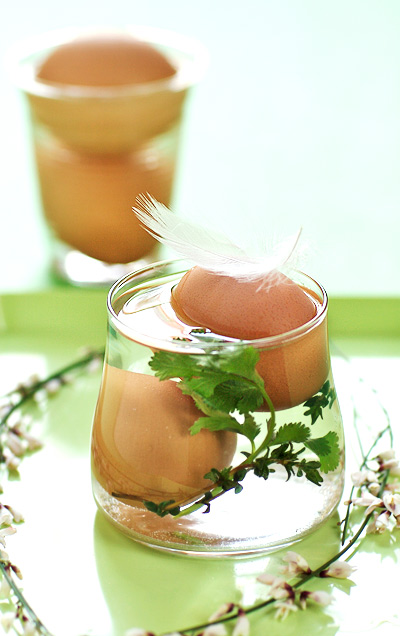
A few weeks ago, with the Easter egg frenzy visible in every magazine I picked to read, I thought about eggs a lot, and feeling easily carried away, I ended up cooking many egg recipes. Amongst them, I came up with the idea of these Dressed up marbled eggs.
Pille — who shares the same love for beets as me — is the one who inspired me to dye hard boiled eggs again. I had not done so in quite a while, so practicing a little again was fun.
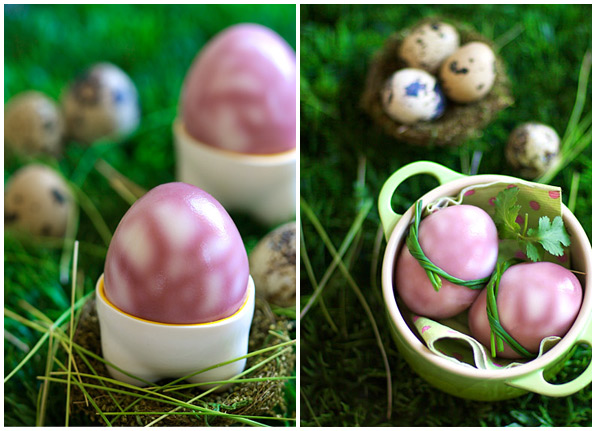
The technique is easy: hard-boil your eggs the way you normally do, crack the shells by tapping them gently on a cutting board, for example — which is what gives the pattern to the eggs — and then, place the eggs in dyed water for about 1 hour 30 minutes (the longer you leave them in the infused water, the more colored they become). I dyed mine with beet root juice diluted in water.
Then, create according to your fancy and taste to dress up your hard boiled eggs. I imagined a topping made of fresh anchovies, horseradish, fleur de sel, and a dash of pepper.
With a twig of chive tied around, the eggs looked like small packages of love and goodness easily dropped into the mouth; a recipe easy to prepare, wonderful enjoyed as a light finger food appetizer, or a nutritious snack to fulfill a sudden craving during the day.
Wouldn’t you too, like my dad and I, enjoy the bounty mother nature keeps for us in simple food like hard-boiled eggs?
Pourquoi chercher compliqué quand le simple peut être si bon ?
(why look for something complex when something easy can be so delicious?)
You need:
- Hard boiled Eggs
- Fresh anchovies marinated in oil
- Chives
- Horseradish preserved in vinegar (or fresh)
- Fleur de sel
- Pepper
Steps:
- Hard-boil your eggs.
- Crack the shells by tapping the eggs gently on a cutting board for example, and place them in a bowl. Cover with water diluted with beet juice. Let the eggs sit like this for about 1 hour 30 minutes. Then remove the shells.
- Cut the eggs in halves. Place a fresh anchovy on each, and top with horseradish. Tie with a piece of chive around.
- Sprinkle with fleur de sel and pepper.
Ingrédients :
- Oeufs durs
- Anchois frais marinés à l’huile
- Ciboulette
- Raifort au vinaigre
- Fleur de sel
- Poivre du moulin
Étapes :
- Faites cuire vos oeufs en oeufs durs.
- Une fois cuits, tapotez-les légèrement sur une planche à découper pour les fissurer, et mettez-les dans un récipient. Recouvrez de jus de betterave rouge allongé à l’eau froide. Laissez de côté pendant 1 heure 30 minimum. Écalez-les.
- Coupez les oeufs en deux. Placez un anchois sur chaque moitié et ajoutez un peu de raifort. Entourez d’un brin de ciboulette que vous nouez autour.
- Saupoudrez de fleur de sel et de poivre du moulin.
Wow, you had some fun with that! (Though I would have been cursing over trying to tie knots in the chives.) Eggs are indeed wonderful, and what lovely memories you have of collecting them.
those are so pretty! I think the Chinese do something similar with oolong tea and hard boiled eggs!
toujours tes photos étonnantes pour de simples mais so originaux oeufs !! c’est un plaisir du matin sans cesse renouvelé de passer chez toi !
from one egg-lover to another, just lovely and delicious-looking! i just recently stumbled upon your blog and am already a fan.
I think that it’s possible to have green effects with matcha tea, healthy and tasty ! I think it will be one of my next recipe on my blog. Chocolat of Cookinginrome
We used to have chickens as pets in our backyard, they used to do crazy cute things and I used to love collecting the eggs too. I’ve never seen yolks as yellow as from our chickens, not even in store bought free-range eggs! It is such a shame that as a child, I didn’t like eggs 🙁
Le printemps t’inspire d’une belle façon !
Absolutely gorgeous. I don’t even have words to describe your photos anymore Bea. So delicate and full of light! I didn’t grow up in a farm but my grandparents did live in one so on Sundays we used to go visit them. I always helped them get the eggs from the chicken coupe and the leeks from the garden to take home. Those two smells are still with me today.
C’est trop beau. Vivement le printemps qui tarde tant à venir ici. Nous avons eu de la neige ce matin à Paris.
Bonne journée à toi.
so cute~
yummy!
I’ve just been talking about my egge consumption with a friend. I don’t worry in the slightest and I do eat a lot of eggs, I just don’t think I can cut down! This evening for example, I am making a salad and I didn’t want odd meat or fish – eggs were the perfect solution!
j’aime les ouefs durs! actually, i love eggs cooked any way! i am lucky enough to have a farmer’s market that sells fresh eggs. your photos are such a beautiful treat!
Lovely! My 9 year old daughter who is learning to cook aand to eat, will love making these for our next picnic. She learned a similar idea from an Italian Grandma at Easter. And she too loves the chicken coop and chickens at my parents at my family farm [and one old duck named Jamimia]. Thank you for your sharing.
Il ne faut pas oublier “l’ile flottantte”!…
I will never, ever bow to the worries about eggs and health. They are too perfect a food and are beautiful. There is something mystical about them. And chickens are about the most charming, goofy beings on the earth. Your photos are lovely and perfectly composed to show the magnificent simplicity of the…egg.
One of my father favorite snacks was hard boiled eggs. So I can relate to the sentimental aspect. I have to admit that I never colored my eggs. Your marbled eggs look so lovely that you will encourage me to start doing it. Your pictures are inspiring, as usual. Give me ideas for a Sunday brunch.
We use to have a lovely farm in the country in New Jersey where my dad would collect the eggs and my mom would cook. I truly have never been an egg fan, but you images are so lovely and inviting that perhaps this could change.
Have you ever made pickeled eggs? My grandmother still makes them every year for easter. I do not have the recipe, b/c I do not like them, but basically you “pickle” hard boiled eggs (out of the shell) in a beet juice and vinegar (amoung other things I’m sure). They are still a family favorite and I’m sure I could get you the recipe if you’re interested. On a site note… any suggestions for quail eggs? I have never cooked them and just bought a dozen from a local Asian grocery store. Thanks and love the blog!
Wow… never heard of the technique, but wow.
J’adore cette idée originale d’oeufs marbrés, c’est si joli!
Et moi non plus, je ne m’inquiète jamais de ma (sur-) consommation d’oeufs! 😉
Love the new look on your site – Fantastic! Love this posting about eggs as well, the photography is very pleasant! Thanks for sharing.
Des oeufs en rose..c’est tout simplement magique…encore bravo Béatrice de ce beau billet..Je me régale de voir tes photos..Bonne semaine à toi
First off LOVE the pictures of the chickens…I am a huge chicken fan. Second, I am so on board of the idea of using the beets to color them. What fun.
Beautiful story, beautiful photos, as always. Regarding egg consumption, you really don’t have to worry. It turns out that the lecithin in eggs actually prevents the absorption of cholesterol. So for most people, eating one or two eggs a day is not a problem.
I’m flattered, Bea! Thank you so much for the link love, and I’m glad to hear that you enjoyed your marbled beetroot eggs (to Kat, who mentioned Chinese tea eggs above – that’s exactly where I got the inspiration from:)
Many thanks everyone for your nice words. I really enjoy hearing your egg stories too. And yes, I knew about the Chinese tea infused eggs too. But I loved the idea of beets, just because I am a real sucker for beets — and reed — under all its forms 😉
Comme c’est joli! On a envie de croquer dans tout ça…
Fantastic photos, as always. I just love eggs, such a fantastic ingredient. I too have wanted to try Pille’s eggs, they look marvellous.
Love your marbled eggs Bea. The photos say it all!
I forgot to mention about quail eggs. To cook them, I hard boil them for 3 mins only, then place them in iced water. They are more delicate than regular eggs. Break easily and shell does not come off as easily, but not a problem all the same. Full of flavor, and so cute on top!
I found something in which we differ: hard boiled eggs…had too many on hikes and picnics as a kid!!The eggs are gorgeous!
My god they’re so pretty!
Pingback: fleur de les
Pingback: 1/100 « MEET THE COHENS
très bonne idée pour les oeufs…. ma mère avait pour l’habitude de faire qu’en on était petit pour paques avec des pelures d’oignon les coques était bien orange/brun et elle en craquelait qq en un pour faire une jolie dessin sur l’oeufs
Pingback: The Perfect Hard Boiled Egg | artist-at-large | Paris
Pingback: Eggs « FoodBits