
“Oh, you look so French,” the woman told me when she reached the page where one of my photos showed on my blog. “Really?” I replied hesitantly. I hardly knew her and did not want to sound too curious and intrigued. But truth being said, inside, I was dying to ask her: “But WHAT do you mean?” After hanging up, I rushed to the large mirror hung above the living-room fireplace and looked at my face. Was it my nose? My teeth? My haircut or the way I move my mouth when I speak.
What was it?
[This? Spring in Boston, finally.]


“Elle exaggère, évidemment,” I thought while examining my face closely, looking for what could be an indication that she was right. In fact, I did not even know what to look for. “She is only saying this because I am speaking to her and she obviously must have noticed my accent“. Well yes, it will sound cliché but I am still trying to manage to speak or write English like a native. And after ten years living overseas, I imagined that it would get better with time. But you know, sometimes I think it is actually getting worse. Every day I have to work at it. For example, take the following. Without counting the occurrences when I feel as if I cannot speak either language well, I also have to make real efforts to lose my habit — French I am told — of adding “euh” to punctuate the ends of my words. Especially after P. teases me and I get really upset. I don’t add euh. Why do you say this? But he is right. A random “Stop it!” becomes “Stop it-euuuuhhh“. Once I asked a friend whether I should add that I was French in an email I was preparing to send for a job, and he replied “Ahahah, I think your voice will make it clear“. Why is this foreign language not flowing like it would — or used to — in French? Why do I have to be assise entre deux chaises (being stuck between the two, literally sitting between two chairs)? In spite of the fact that I know well that I am not alone in this battle, I nonetheless wish that I could write in English as naturally as I wake up in the morning every day. After ten years, one would think it were possible, no?
Of course, as I think again about this woman talking to me on the phone, I come to realize that she is not the first one to tell me that I look French. But despite the many times when this happened, I still do not know what it means. And maybe I will never know. I have learned that this is obviously one thing that can more easily be seen on others. The reason why am I able to say “Oh, she looks so English or “Look at this woman, she could not be more Russian” when I am unable to see or believe that I look French boils down to how much I know about a country and its people. If I can tell that someone is Russian when I see him or her, it is perhaps because I have many Russian friends living in Boston. I can do this for them but not for myself. And so, I then started to question and think about this even more. What about my food? Does it feel French at all?
“Ah mais oui,” P. answered when I asked him.
“Ah bon ? (Really?)”, I replied. “Et une soupe et une tartine, c’est français ça aussi ? (And a soup and a tartine, is it French too?)”
I just don’t know anymore. One thing is sure. If it is, then I am definitely looking very French. At least I will be able to check it out for myself over the course of this week when I will be eating and speaking as locals do. Being and looking French. Perhaps. I surely hope that I will not have forgotten what it is like.
Note: I adapted the soup from a recipe I saw in the French March/April 2007 edition of the magazine Elle à Table (which I finally received in early May, two months after the release day). This is also part of these unusual events of living abroad and being told:
“Ah mais ce n’est pas possible, on ne peut pas l’envoyer avant la fin avril” (It is not possible, we cannot send it before the end of April).
“WHY? ” I had to ask, doing my best to remain as polite as one can possibly be after reading this odd response! “You DO realize that if I read about Easter recipes after Easter, it is somewhat gênant (annoying). I am subscribed to many foreign food magazines, English, Australian, but I have never heard of such a thing before!”
“Well, the magazine is sent from France.”
I did not comment besides regrettably canceling my subscription (although I was dying to ask them whether the magazine was actually coming on a boat meant to sail around the world first). A real shame since I really liked this magazine.
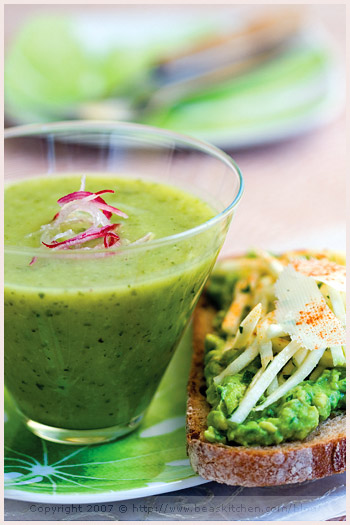
You need:
For the tartines:
- 2 nicely-sized slices of country bread
- 1 avocado, ripe
- 1 Tbsp coriander, chopped
- 1 Tbsp chives, chopped
- 2 tsp lime juice
- 1 tsp fish sauce
- Pinch of cayenne pepper
- Celery root, grated and seasoned with a vinaigrette made of French mustard, white balsamic vinegar, oilve oil and freshly chopped parsley
- Pinch of paprika
- Shaves of Manchego cheese, or any sheep cheese of this texture
For the green soup:
- 1 yellow onion
- 3 medium-sized zucchinis
- 2 parsnips
- 3.5 oz fava beans, shelled (frozen when not fresh)
- Salt and pepper
- Fresh coriander
- Olive oil
- 3 cups water
- A few pink radishes
- Crème fraîche
Steps:
- To prepare the soup, take a large thick-bottomed pot and cook the onion in 2 Tbsp olive oil for a few min.
- Peel the parsnips. Wash the zucchinis and dice all vegetables coarsely.
- Add them to the onions and cook for 5 min. Cover with the water and continue to cook for 20 min, or until all vegetables are tender.
- Add the fava beans and continue to cook for 5 min.
- Mix your soup with a hand mixer or food processor. Add the chopped coriander, and season with salt and pepper. Serve with a grated pink radish (and cream if you like).
- To prepare the tartines, start by mashing the avocado with a fork.
- Add the coriander, lime juice, chives, fish sauce and a dash of cayenne pepper.
- Prepare the celery root (grated) and season it with the vinaigrette and parsley.
- Toast the slices of bread and top with the avocado cream.
- Add the celery and cheese shaves. Finish with some paprika.
- Eat the soup with the tartines.
Tartine avocat, céleri rave et fromage
Ingrédients :
Pour les tartines:
- 2 belles tranches de pain de campagne grillées
- 1 avocat mûr écrasé à la fourchette
- 1 càs de coriandre fraîche hachée
- Ciboulette
- 2 càc de citron vert
- 1 càc de nuoc-mâm
- Pincée de cayenne
- Céleri rave râpé, assaisonné avec une vinaigrette moutarde balsamique blanc et huile d’olive, persil
- Pincée de paprika
- Copeaux de fromage, Manchego ou un brebis
Pour la soupe verte :
- 1 oignon jaune
- 3 courgettes moyennes
- 2 panais
- 100 g de fèves décortiquées (surgelées si difficile à trouver fraîches)
- Sel et poivre
- Coriandre
- Huile d’olive
- 750 ml d’eau
- Quelques radis roses
- Crème fraîche
Étapes :
- Pour préparer la soupe, faites revenir l’oignon dans 2 càs d’huile d’olive dans une cocotte à fond épais.
- Pelez les panais. Lavez les courgettes et coupez tous les légumes en gros dés.
- Ajoutez-les aux oignons et faites suer pendant 5 min. Couvrez avec l’eau et cuisez environ 20 min, jusqu’à ce que les légumes soient tendres.
- Ajoutez les fèves et poursuivez la cuisson pendant 5 min.
- Moulinez la soupe et rectifiez l’assaisonnement. Ajoutez la coriandre hachée et un radis rose râpé.
- Pour préparer les tartines, commencez par écraser l’avocat à la fourchette.
- Ajoutez la coriandre, le jus de citron, la ciboulette et le nuoc-mâm, et une pincée de cayenne.
- Préparez le céleri rave avec la vinaigrette et le persil.
- Faites griller les tranches de pain et tartinez-les de la crème d’avocat.
- Ajoutez ensuite le céleri et des copeaux de fromage. Finissez par une touche de paprika.
- Dégustez la soupe avec les tartines.
Bea, I could not have said it any better! I am told very often the same thing about looking French and often wonder if they think it before I open my mouth, and I don’t have much of an accent.
I hear you about the French magazines, I cancel a bunch of them because I was tired of having Christmas recipes on Valentine’s Day!
Lovely recipe!
Bea, I feel your pain – after living in Italy for almost 4 years, a magazine article recently mentioned my “American accent” and it felt like a slap in the face! I think people that make fun have obviously never been “different” themselves….they’re either jealous or ignorant.
Your English is wonderful, at least the written! Be proud.
quelle merveille! encore fabuleux, je n’ai plus de mots!
Ca me fait sourire, ta prose! Je ne sais pas pourquoi nous avons un accent du tonnerre. En allemand, ça ne rate pas c’est pareil! En revanche, en polonais, je dois dire que non, les français n’ont pas d’accent, ou presque pas!
Pour ce qui est de la recette, c’est WSPANIALE, génial quoi, enfin pour le coup, je ne trouve pas les mots en français!
I love this beautiful soup !
Ah, looking French!! Growing up, I spent numerous vacations in Turkey where one of my favorite games was to guess who the French tourists were! I have had some success with the men, usually I could tell by the eyes, it’s hard to explain, but they look like they will tell you everything. Also, I think French usually look cute and have small features, the picture on your “about” page shows all this (plus the eyes, I think), when I 1st saw your picture, I also remembered thinking “she looks French” 🙂 But overall, it’s more an overall feeling than anything else, it’s just hard to explain, no?
As for elle a table, I could not agree more. I am so upset to receive their Christmas issue when everyone else is thinking about losing weight!! I really like the magazine, though, and don’t have the courage to cancel the subscription (they have given me good dinner ideas when all I could think about was opening a can of soup). Do you also subscribe to Regal? I am wondering if they are any better when it comes to promptness.
this soup looks very nice, love the green color. I want to look French too 🙂
Bea – I am not sure what this person meant, havnt a clue. I can tell you that I see kind smile lines at your eyes and an open genuine smile. I dont see a country, I see a friendly person. Its a great photo!
What a strange thing to say? Marie-Laure, one of my darling friends who happens to be an international student over here from France, just looks like a girl to me, I could not tell she was French till she opened her mouth (and then I fell in love with her accent! Hehehe!).
As always, beautiful photography – the green looks so luscious and vibrant…ahh, it makes me feel jealous, as everything is turning brown here in preparation for winter 🙁
Oh Béa, such a great post. I went to France when I was 17 and so wanted to look like the French girls – the walk, the talk, the clothes, I know exactly those things that make you so French of which you are not aware. I worked on it for a long time (I’m now a French professor in New York) and finally resigned myself to being not American like other people, but obviously not French either.
Bah. Accents are beautiful. Unless it’s a Boston accent!!
Ma chère, je te comprends absolument. Étant une canadienne anglophone qui ait passé une année à Tours, je peux absolument comprendre la frustration d’avoir une compréhension parfaite de la langue seconde, mais n’ayant ni l’accent, ni la grammaire de quelqu’un parlant leur langue maternelle.
Pourtant, il y a certainement des pires choses que d’avoir l’air d’une française, non? 🙂
(and picture that said with the oddest of French accents, straddling the middle ground between Canadian and French…)
Love your blog, as always.
i konw the true romantic and French feeling in your photos~
love your photos~ love u~
Bea, nothing wrong with sounding French – but I think that your attention to detail and exquisite composition are international skills, do you agree?
Même à l’autre bout de la terre, on garde un peu de ses racines.
Au fait comment dit-on en français : totally addicted to Bea’s blog ? 😉
You look just like Bea to me, do not change anything.
oui, perdre son accent, c est difficile mais pas impossible. j ai eu un professeur francais de phonetique americaine qui parlait comme un native. Mais une identite nationale transparait aussi dans les mouvements, le comportement… Entouree d etudiants etrangers, j arrive souvent a deviner la nationalite des italiens espagnols americains simplement par leur physique (vetements, visage…)
Sophie – on pourrait dire: accro à fond au blog de Béa.
Oh Bea! I’m sure the lady meant it in a good way. I certainly would love for someone to tell me I look French, heehee. In any case, French or no, you look like a wonderful person 🙂
I’m thoroughly impressed by anyone who can blog so wonderfully in a language that isn’t their first I can speak french fairly fluently, but my written french is atrocious.
That’s part of who you are, so don’t try to change anything!
You know, I’m part English and lived all my life in Switzerland, but there are always some people who like to make fun of my supposed “English accent” when I speak my mother tongue (French), although I don’t believe that I have one….
D’un côté, je fais de gros efforts pour parler avec The BBC accent et de l’autre, plusieurs anglophones m’ont dit adorer entendre une femme parler avec l’accent français, alors…
Quoi qu’il en soit, j’adore votre prose anglaise où surgit par endroit une expression typiquement française.
Oh, language … I recognize this. Being from Sweden and now living in the US, I always had this odd idea that my English was perfect; however, I don’t think I can open my mouth to talk to a stranger before he/she asks where I’m from. Is it really that obvious? Probably …
On a second note, I think my Swedish is becoming a bit rusty and that’s even worse. I had to write a letter, a serious letter, some weeks ago and it took me forever. Suddenly, I’m questioning expressions I’ve used for 200 years! I better just keep my mouth shut … 🙂
Merci pour ces belles photos ! Je pensais que l’accent français était so cute !
Bea
what a delight! i love the green! i think it will go well with my new addiction- the no-knead bread from Jim Lahey [NYT Nov 06/Steingarten last mos Vogue] – I meant to make it earlier but could only bring myself to bake bread again since Dec on Cinco de Mayo [ironically. or not!] You must try it. J is test driving it!
Enjoy your home visit.
xox
De l’eau dans la soupe, c’est une bonne idée. D’autant plus que les ingrédients sont goûteux en soi. Tes photos sont à tomber!
Soupe et tartine, c’est indéniablement français.
J’allais dire comme Tarzile. J’ajouterai que ton petit foulard noué serré a ce petit quelque chose d’européen, français donc peut-être un peu oui. Quant à tes recettes, je dirais plutôt qu’elles me font beaucoup voyager chaque fois, et pas seulement en France ou à Boston, mais un peu partout dans le monde. Ta passion des voyages se reflète dans ta cuisine aussi.
Je ne connaissais pas le vinaigre balsamique blanc. Ça goûte bien différent?
Sara, thank you. I think it is a life long learning experience, isn’t it? We are so many in this situation!
Alhya, merci encore une fois.
Lisanka, tiens marrant de lire qu’il n’y a pas d’accent quand un francais parle polonais. Et tu as raison, il y a tant de fois ou je ne trouve pas les mots!
Bergeou, thank you.
Estelle, oh yes, I sometimes play this game too to try to spot the French (when it is not me, I can oddily enough). Just being back to France on a flight, and I could so easily tell who was French 😉 As to the magazines, I wanted to subscribe to Regal but it does not seem that they do so internationnally. I tried and never got a response. Encore une autre de ces choses 😉 You are brave not cancel the subscription. I tried but got so frustrated with it! For example, there was a fun chocolate contest that I heard of when it was over. See the point??
Kat, ahah, you are funny. I think you are great the way you are!
Nika, thanks for your kind words!
Ellie, thank you! Well sometimes you can tell if someone comes from a specific country. This is what this woman meant, I suppose. I myself can guess quite accurately for some countries that I know well, but not for others. This has always fascinated me. You will enjoy the fall, it is a nice season too! Especially in Melbourne I am sure!
Mary, this is so nice to read this from you. I was not aware you were teaching French. Did you read Nancy Huston’s Nord perdu? I loved the book!
Tammy, ahah, indeed! I agree.
Mrbunsrocks, ah oui, je ne me plainds pas, mais je suis parfoid juste frustree de ne plus savoir ni parler anglais ni parler francais. Alors je parle franglais 😉
Yoyo, thank you.
Jennie, oh no, I do not think this woman meant it as it is a bad thing. But just an observation, which I think is quite interesting.
Sophie, ahah, tu es trop mignonne. Merci!
Gracianne, good. That is a good thing then!
Aurelie, completement d’accord, les vetements et le visage sont des indications.
Joey, yes I think she did, I have no doubt. Thank you!
Brilynn, oh I was not aware you spoke French. Nice. And yes I guess it is only practice. Thanks for your encouragements.
Rosa, P. my hubbie is born in the US but his parents are Irish and he grew up between Dublin and the US, so this also gives another dimension!
Adeline, merci beaucoup! Ah oui, quand j’etais a la fac, on voulait aussi qu’on parle l’anglais de la BBC!
Christina, oh yes, I know exactly what you mean and describe. How to no longer be able to write well in one’s mother-in-tongue. It comes back, but it is like a rusty machine.
Fabienne, merci.
Kim, oh yes, I have heard about this bread. I have not yet tried. I actually baked a country style loaf yesterday with spelt to make sandwiches for the plane. P. can eat now the leftovers.
Tarzile, merci. Tu vois, je n’etais plus sure, le coup de la soupe et de la tartine.
Ninnie, ah oui, c’est vrai, je n’avais pas pense au foulard 😉 Merci, il faut absolument que tu goutes au vinaigre balsamique blanc. Je le trouve plus leger. mais aussi bien quand tu ne veux pas “colorer” ton plat avec la couleur du vinaigre. Ca reste neutre et c;est pratique.
So I guess, here I am in France, waiting for my next connection.
Béa, I guess this is one of those things you get used to, being told you look French. Most times it is sort of a compliment anyway. I know I still sound foreign to many, sort of British to anglo-Canadians, north American to Brits here, and oddly enough Québécoise to French friends and family members 😉 Dur, dur d’être un parfait caméléon linguistique!
I got tired of this in Dublin when I heard it about my baby who was not even three months! She was in pyjamas (not petit bateau ones) all day, and her language skills were well, a work in progress. I guess, it all depends who tells you so, and how it is done.
Love you soup, tried it a few days ago after a short trip to Paris. I have given up subscribing to Elle à table and Cuisine & Vins de France, I get them as a treat when I travel instead.
The tartine is so beautiful. Could this soup be served cold? It looks so beautiful and I wonder if it would work for a plane trip lunch!
Bonjour Bea!
Well, I will venture to make a general statement to you: that in the U.S. when someone says you “look French”, they are complimenting you. In traditional American culture, looking like or being a French woman has long been held to be something positive, not negative.
I confess I’ve actually been asked for years if I’m French (of French descent) and it’s so peculiar to me, because I have no French blood AT ALL (I wish!). But I DO ask people why they think that — and they always say something complimentary to explain it. I used to find it rather odd but now I think it’s the nicest compliment I get. Not that I’m boasting… 🙂
(really — I’m not — I don’t think I look French, myself).
As far as English goes, you have a very, very good grasp of the language. I’m envious. I am trying to learn French and my biggest problem is that I’m studying it alone and have no French-speakers or tutors (which are so expensive, unfortunately) to help me so I sound like a demented toddler.
I’m curious: Bea, when did you first begin to study English…?
When an American comments that someone looks French, this is most surely a compliment! As an American, I have been trying to create a French look for myself for years.;) But you know it is something you see in France all the time, feminine, stylish, confident woman of every age and socioeconomic group.Women who seem to look fabulous without having obsessed over it or suffered to obtain it. And of course you know there are so many authors that mused about this- Peter Mayle and Mireille Guiliano to mention the most well known.
Delphine, I guess it is true. Le cameleon linguistique, pas toujours facile. And glad to hear you enjoyed the soup! Merci encore.
Tanna, thank you! Don’t think it would survive well a plane ride, I am afraid! 😉
Nan, thank you. It is required daily work to speak a language well, isn’t it? Every day. I started when I was twelve or so, but then what really made the difference was to leave in an English-speaking country. The best way, besides being married to an Irish/American 😉
Jeana, i have to check Peter Mayle. I have not read his writings.
I am 100% French (means my parents and grandparents are French) and I spent the last 10 years abroad… people keep telling me I must be Italian for sure… Now, I do feel weird indeed!
but why, you do look so french. and i think it is a compliment. i think french women have this special beuty, maybe its what they call “bien dan ca peau” when i lived in paris, sometimes people thought i was french, and i loved it! anyway, i love le petit accent francaise, that i can actually hear, when i read your site in english 🙂 its perfect but especially when youa retalking about something french, the french use much more elegant words to express everything. so when translated its a more elegant english. i think..
It’s an expression in the face;the eyes are very soft and open and kind at least for the men.
I was searching your blog for soups (it’s a rainy August day in Tennessee and I’m craving autumn, and all the warm and delicious autumn-y things I can create in my kitchen) and came across this delightful post. Ça, alors. Ça je comprends, parfaitement. I’m not going to attempt to write in French (it’s embarassing, really… je me sent que je n’arriverai jamais.) but even after a year of living with my French boyfriend, I still don’t understand why I “look so American” or even why certain clothes I wear or mannerisms I have add to this impression. Sigh.
Anyway, I love your site. It inspires me so much. Thank you for all your stories, recipes, and insights!
No, I wouldn’t say you look French, not remembering those scrawny, crew-cutted poseurs of New Caledonia, everyone of whom seemed to have been cloned. All in 4″ heels, all in the same sort of dress, all with 3 gold chains around the neck, awful leathery tans, never a smile, and always, always with a cigarette in their hand. YOU, Bea, look like a nice, ordinary human being!